

Verified DP-100 Exam Dumps PDF [2022] Access using LatestCram
Try Best DP-100 Exam Questions from Training Expert LatestCram
NEW QUESTION 158
You are using the Hyperdrive feature in Azure Machine Learning to train a model.
You configure the Hyperdrive experiment by running the following code:
For each of the following statements, select Yes if the statement is true. Otherwise, select No.
NOTE: Each correct selection is worth one point.
Answer:
Explanation:
Reference:
https://docs.microsoft.com/en-us/azure/machine-learning/how-to-tune-hyperparameters
NEW QUESTION 159
You are using the Azure Machine Learning Service to automate hyperparameter exploration of your neural network classification model.
You must define the hyperparameter space to automatically tune hyperparameters using random sampling according to following requirements:
The learning rate must be selected from a normal distribution with a mean value of 10 and a standard deviation of 3.
Batch size must be 16, 32 and 64.
Keep probability must be a value selected from a uniform distribution between the range of 0.05 and 0.1.
You need to use the param_sampling method of the Python API for the Azure Machine Learning Service.
How should you complete the code segment? To answer, select the appropriate options in the answer area.
NOTE: Each correct selection is worth one point.
Answer:
Explanation:
Explanation:
In random sampling, hyperparameter values are randomly selected from the defined search space. Random sampling allows the search space to include both discrete and continuous hyperparameters.
Example:
from azureml.train.hyperdrive import RandomParameterSampling
param_sampling = RandomParameterSampling( {
"learning_rate": normal(10, 3),
"keep_probability": uniform(0.05, 0.1),
"batch_size": choice(16, 32, 64)
}
Reference:
https://docs.microsoft.com/en-us/azure/machine-learning/service/how-to-tune-hyperparameters
NEW QUESTION 160
You need to configure the Permutation Feature Importance module for the model framing requirements.
What should you do? To answer, select the appropriate options in the dialog box in the answer area-NOTE:
Each correct selection is worth one point.
Answer:
Explanation:
NEW QUESTION 161
You configure a Deep Learning Virtual Machine for Windows.
You need to recommend tools and frameworks to perform the following:
* Build deep neural network (DNN) models
* Perform interactive data exploration and visualization
Which tools and frameworks should you recommend? To answer, drag the appropriate tools to the correct tasks. Each tool may be used once, more than once, or not at all. You may need to drag the split bar between panes or scroll to view content.
NOTE: Each correct selection is worth one point.
Answer:
Explanation:
Explanation:
Box 1: Vowpal Wabbit
Use the Train Vowpal Wabbit Version 8 module in Azure Machine Learning Studio (classic), to create a machine learning model by using Vowpal Wabbit.
Box 2: PowerBI Desktop
Power BI Desktop is a powerful visual data exploration and interactive reporting tool BI is a name given to a modern approach to business decision making in which users are empowered to find, explore, and share insights from data across the enterprise.
References:
https://docs.microsoft.com/en-us/azure/machine-learning/studio-module-reference/train-vowpal-wabbit-version-8-model
https://docs.microsoft.com/en-us/azure/architecture/data-guide/scenarios/interactive-data-exploration
NEW QUESTION 162
You run an experiment that uses an AutoMLConfig class to define an automated machine learning task with a maximum of ten model training iterations. The task will attempt to find the best performing model based on a metric named accuracy.
You submit the experiment with the following code:
You need to create Python code that returns the best model that is generated by the automated machine learning task.
Which code segment should you use?
- A. best_model = automl_run.get_output()[1]
- B. best_model = automl_run.get_details()
- C. best_model = automl_run.get_file_names()[1]
- D. best_model = automl_run.get_metrics()
Answer: A
Explanation:
The get_output method returns the best run and the fitted model.
Reference:
https://notebooks.azure.com/azureml/projects/azureml-getting-started/html/how-to-use-azureml/automated- machine-learning/classification/auto-ml-classification.ipynb
NEW QUESTION 163
You are performing a filter-based feature selection for a dataset to build a multi-class classifier by using Azure Machine Learning Studio.
The dataset contains categorical features that are highly correlated to the output label column.
You need to select the appropriate feature scoring statistical method to identify the key predictors.
Which method should you use?
- A. Chi-squared
- B. Spearman correlation
- C. Kendall correlation
- D. Pearson correlation
Answer: D
Explanation:
Pearson's correlation statistic, or Pearson's correlation coefficient, is also known in statistical models as the r value. For any two variables, it returns a value that indicates the strength of the correlation Pearson's correlation coefficient is the test statistics that measures the statistical relationship, or association, between two continuous variables. It is known as the best method of measuring the association between variables of interest because it is based on the method of covariance. It gives information about the magnitude of the association, or correlation, as well as the direction of the relationship.
Incorrect Answers:
C: The two-way chi-squared test is a statistical method that measures how close expected values are to actual results.
Reference:
https://docs.microsoft.com/en-us/azure/machine-learning/studio-module-reference/filter-based-feature- selection
https://www.statisticssolutions.com/pearsons-correlation-coefficient/
Perform Feature Engineering
Testlet 1
Case study
Overview
You are a data scientist in a company that provides data science for professional sporting events. Models will use global and local market data to meet the following business goals:
* Understand sentiment of mobile device users at sporting events based on audio from crowd reactions.
* Assess a user's tendency to respond to an advertisement.
* Customize styles of ads served on mobile devices.
* Use video to detect penalty events
Current environment
* Media used for penalty event detection will be provided by consumer devices. Media may include images and videos captured during the sporting event and shared using social media. The images and videos will have varying sizes and formats.
* The data available for model building comprises of seven years of sporting event media. The sporting event media includes; recorded video transcripts or radio commentary, and logs from related social media feeds captured during the sporting events.
* Crowd sentiment will include audio recordings submitted by event attendees in both mono and stereo formats.
Penalty detection and sentiment
* Data scientists must build an intelligent solution by using multiple machine learning models for penalty event detection.
* Data scientists must build notebooks in a local environment using automatic feature engineering and model building in machine learning pipelines.
* Notebooks must be deployed to retrain by using Spark instances with dynamic worker allocation.
* Notebooks must execute with the same code on new Spark instances to recode only the source of the data.
* Global penalty detection models must be trained by using dynamic runtime graph computation during training.
* Local penalty detection models must be written by using BrainScript.
* Experiments for local crowd sentiment models must combine local penalty detection data.
* Crowd sentiment models must identify known sounds such as cheers and known catch phrases. Individual crowd sentiment models will detect similar sounds.
* All shared features for local models are continuous variables.
* Shared features must use double precision. Subsequent layers must have aggregate running mean and standard deviation metrics available.
Advertisements
During the initial weeks in production, the following was observed:
* Ad response rated declined.
* Drops were not consistent across ad styles.
* The distribution of features across training and production data are not consistent Analysis shows that, of the 100 numeric features on user location and behavior, the 47 features that come from location sources are being used as raw features. A suggested experiment to remedy the bias and variance issue is to engineer 10 linearly uncorrelated features.
* Initial data discovery shows a wide range of densities of target states in training data used for crowd sentiment models.
* All penalty detection models show inference phases using a Stochastic Gradient Descent (SGD) are running too slow.
* Audio samples show that the length of a catch phrase varies between 25%-47% depending on region
* The performance of the global penalty detection models shows lower variance but higher bias when comparing training and validation sets. Before implementing any feature changes, you must confirm the bias and variance using all training and validation cases.
* Ad response models must be trained at the beginning of each event and applied during the sporting event.
* Market segmentation models must optimize for similar ad response history.
* Sampling must guarantee mutual and collective exclusively between local and global segmentation models that share the same features.
* Local market segmentation models will be applied before determining a user's propensity to respond to an advertisement.
* Ad response models must support non-linear boundaries of features.
* The ad propensity model uses a cut threshold is 0.45 and retrains occur if weighted Kappa deviated from
0.1 +/- 5%.
* The ad propensity model uses cost factors shown in the following diagram: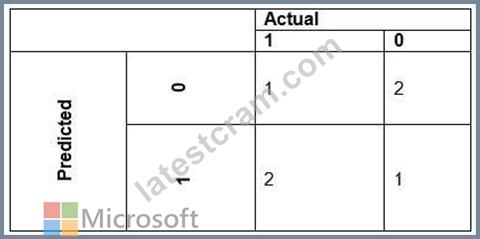
* The ad propensity model uses proposed cost factors shown in the following diagram:
* Performance curves of current and proposed cost factor scenarios are shown in the following diagram:
NEW QUESTION 164
You plan to use the Hyperdrive feature of Azure Machine Learning to determine the optimal hyperparameter values when training a model.
You must use Hyperdrive to try combinations of the following hyperparameter values:
* learning_rate: any value between 0.001 and 0.1
* batch_size: 16, 32, or 64
You need to configure the search space for the Hyperdrive experiment.
Which two parameter expressions should you use? Each correct answer presents part of the solution.
NOTE: Each correct selection is worth one point.
- A. a choice expression for learning_rate
- B. a uniform expression for batch_size
- C. a normal expression for batch_size
- D. a uniform expression for learning_rate
- E. a choice expression for batch_size
Answer: D,E
Explanation:
Explanation
B: Continuous hyperparameters are specified as a distribution over a continuous range of values. Supported distributions include:
* uniform(low, high) - Returns a value uniformly distributed between low and high D: Discrete hyperparameters are specified as a choice among discrete values. choice can be:
* one or more comma-separated values
* a range object
* any arbitrary list object
Reference:
https://docs.microsoft.com/en-us/azure/machine-learning/how-to-tune-hyperparameters
NEW QUESTION 165
You create a binary classification model to predict whether a person has a disease. You need to detect possible classification errors.
Which error type should you choose for each description? To answer, select the appropriate options in the answer area.
NOTE: Each correct selection is worth one point.

Answer:
Explanation:
Explanation
NEW QUESTION 166
You plan to use the Hyperdrive feature of Azure Machine Learning to determine the optimal hyperparameter values when training a model.
You must use Hyperdrive to try combinations of the following hyperparameter values. You must not apply an early termination policy.
learning_rate: any value between 0.001 and 0.1
* batch_size: 16, 32, or 64
You need to configure the sampling method for the Hyperdrive experiment Which two sampling methods can you use? Each correct answer is a complete solution.
NOTE: Each correct selection is worth one point.
- A. Bayesian sampling
- B. Random sampling
- C. No sampling
- D. Grid sampling
Answer: A,B
Explanation:
C: Bayesian sampling is based on the Bayesian optimization algorithm and makes intelligent choices on the hyperparameter values to sample next. It picks the sample based on how the previous samples performed, such that the new sample improves the reported primary metric.
Bayesian sampling does not support any early termination policy
Example:
from azureml.train.hyperdrive import BayesianParameterSampling
from azureml.train.hyperdrive import uniform, choice
param_sampling = BayesianParameterSampling( {
"learning_rate": uniform(0.05, 0.1),
"batch_size": choice(16, 32, 64, 128)
}
)
D: In random sampling, hyperparameter values are randomly selected from the defined search space. Random sampling allows the search space to include both discrete and continuous hyperparameters.
Incorrect Answers:
B: Grid sampling can be used if your hyperparameter space can be defined as a choice among discrete values and if you have sufficient budget to exhaustively search over all values in the defined search space. Additionally, one can use automated early termination of poorly performing runs, which reduces wastage of resources.
Example, the following space has a total of six samples:
from azureml.train.hyperdrive import GridParameterSampling
from azureml.train.hyperdrive import choice
param_sampling = GridParameterSampling( {
"num_hidden_layers": choice(1, 2, 3),
"batch_size": choice(16, 32)
}
)
Reference:
https://docs.microsoft.com/en-us/azure/machine-learning/how-to-tune-hyperparameters
NEW QUESTION 167
You are tuning a hyperparameter for an algorithm. The following table shows a data set with different hyperparameter, training error, and validation errors.
Use the drop-down menus to select the answer choice that answers each question based on the information presented in the graphic.
Answer:
Explanation:
Explanation:
Box 1: 4
Choose the one which has lower training and validation error and also the closest match.
Minimize variance (difference between validation error and train error).
Box 2: 5
Minimize variance (difference between validation error and train error).
Reference:
https://medium.com/comet-ml/organizing-machine-learning-projects-project-management-guidelines-2d2b85651bbd
NEW QUESTION 168
Note: This question is part of a series of questions that present the same scenario. Each question in the series contains a unique solution that might meet the stated goals. Some question sets might have more than one correct solution, while others might not have a correct solution.
After you answer a question in this section, you will NOT be able to return to it. As a result, these questions will not appear in the review screen.
You are creating a model to predict the price of a student's artwork depending on the following variables: the student's length of education, degree type, and art form.
You start by creating a linear regression model.
You need to evaluate the linear regression model.
Solution: Use the following metrics: Mean Absolute Error, Root Mean Absolute Error, Relative Absolute Error, Accuracy, Precision, Recall, F1 score, and AUC.
Does the solution meet the goal?
- A. Yes
- B. No
Answer: B
Explanation:
Accuracy, Precision, Recall, F1 score, and AUC are metrics for evaluating classification models.
Note: Mean Absolute Error, Root Mean Absolute Error, Relative Absolute Error are OK for the linear regression model.
References:
https://docs.microsoft.com/en-us/azure/machine-learning/studio-module-reference/evaluate-model
NEW QUESTION 169
You plan to use automated machine learning to train a regression model. You have data that has features which have missing values, and categorical features with few distinct values.
You need to configure automated machine learning to automatically impute missing values and encode categorical features as part of the training task.
Which parameter and value pair should you use in the AutoMLConfig class?
- A. enable_voting_ensemble = True
- B. task = 'classification'
- C. exclude_nan_labels = True
- D. featurization = 'auto'
- E. enable_tf = True
Answer: D
Explanation:
Featurization str or FeaturizationConfig
Values: 'auto' / 'off' / FeaturizationConfig
Indicator for whether featurization step should be done automatically or not, or whether customized featurization should be used.
Column type is automatically detected. Based on the detected column type preprocessing/featurization is done as follows:
Categorical: Target encoding, one hot encoding, drop high cardinality categories, impute missing values.
Numeric: Impute missing values, cluster distance, weight of evidence.
DateTime: Several features such as day, seconds, minutes, hours etc.
Text: Bag of words, pre-trained Word embedding, text target encoding.
Reference:
https://docs.microsoft.com/en-us/python/api/azureml-train-automl-client/ azureml.train.automl.automlconfig.automlconfig Develop models Testlet 1 Case study Overview You are a data scientist in a company that provides data science for professional sporting events. Models will use global and local market data to meet the following business goals:
* Understand sentiment of mobile device users at sporting events based on audio from crowd reactions.
* Assess a user's tendency to respond to an advertisement.
* Customize styles of ads served on mobile devices.
* Use video to detect penalty events
Current environment
* Media used for penalty event detection will be provided by consumer devices. Media may include images and videos captured during the sporting event and shared using social media. The images and videos will have varying sizes and formats.
* The data available for model building comprises of seven years of sporting event media. The sporting event media includes; recorded video transcripts or radio commentary, and logs from related social media feeds captured during the sporting events.
* Crowd sentiment will include audio recordings submitted by event attendees in both mono and stereo formats.
Penalty detection and sentiment
* Data scientists must build an intelligent solution by using multiple machine learning models for penalty event detection.
* Data scientists must build notebooks in a local environment using automatic feature engineering and model building in machine learning pipelines.
* Notebooks must be deployed to retrain by using Spark instances with dynamic worker allocation.
* Notebooks must execute with the same code on new Spark instances to recode only the source of the data.
* Global penalty detection models must be trained by using dynamic runtime graph computation during training.
* Local penalty detection models must be written by using BrainScript.
* Experiments for local crowd sentiment models must combine local penalty detection data.
* Crowd sentiment models must identify known sounds such as cheers and known catch phrases. Individual crowd sentiment models will detect similar sounds.
* All shared features for local models are continuous variables.
* Shared features must use double precision. Subsequent layers must have aggregate running mean and standard deviation metrics available.
Advertisements
During the initial weeks in production, the following was observed:
* Ad response rated declined.
* Drops were not consistent across ad styles.
* The distribution of features across training and production data are not consistent Analysis shows that, of the 100 numeric features on user location and behavior, the 47 features that come from location sources are being used as raw features. A suggested experiment to remedy the bias and variance issue is to engineer 10 linearly uncorrelated features.
* Initial data discovery shows a wide range of densities of target states in training data used for crowd sentiment models.
* All penalty detection models show inference phases using a Stochastic Gradient Descent (SGD) are running too slow.
* Audio samples show that the length of a catch phrase varies between 25%-47% depending on region
* The performance of the global penalty detection models shows lower variance but higher bias when comparing training and validation sets. Before implementing any feature changes, you must confirm the bias and variance using all training and validation cases.
* Ad response models must be trained at the beginning of each event and applied during the sporting event.
* Market segmentation models must optimize for similar ad response history.
* Sampling must guarantee mutual and collective exclusively between local and global segmentation models that share the same features.
* Local market segmentation models will be applied before determining a user's propensity to respond to an advertisement.
* Ad response models must support non-linear boundaries of features.
* The ad propensity model uses a cut threshold is 0.45 and retrains occur if weighted Kappa deviated from
0.1 +/- 5%.
* The ad propensity model uses cost factors shown in the following diagram:
* The ad propensity model uses proposed cost factors shown in the following diagram:
* Performance curves of current and proposed cost factor scenarios are shown in the following diagram:
NEW QUESTION 170
You have a dataset that contains 2,000 rows. You are building a machine learning classification model by using Azure Learning Studio. You add a Partition and Sample module to the experiment.
You need to configure the module. You must meet the following requirements:
Divide the data into subsets
Assign the rows into folds using a round-robin method
Allow rows in the dataset to be reused
How should you configure the module? To answer, select the appropriate options in the dialog box in the answer area.
NOTE: Each correct selection is worth one point.
Answer:
Explanation:
References:
https://docs.microsoft.com/en-us/azure/machine-learning/studio-module-reference/partition-and-sample
NEW QUESTION 171
You are tuning a hyperparameter for an algorithm. The following table shows a data set with different hyperparameter, training error, and validation errors.

Answer:
Explanation:
NEW QUESTION 172
You are building a machine learning model for translating English language textual content into French language textual content.
You need to build and train the machine learning model to learn the sequence of the textual content.
Which type of neural network should you use?
- A. Convolutional Neural Networks (CNNs)
- B. Multilayer Perceptions (MLPs)
- C. Recurrent Neural Networks (RNNs)
- D. Generative Adversarial Networks (GANs)
Answer: C
Explanation:
Explanation
To translate a corpus of English text to French, we need to build a recurrent neural network (RNN).
Note: RNNs are designed to take sequences of text as inputs or return sequences of text as outputs, or both.
They're called recurrent because the network's hidden layers have a loop in which the output and cell state from each time step become inputs at the next time step. This recurrence serves as a form of memory. It allows contextual information to flow through the network so that relevant outputs from previous time steps can be applied to network operations at the current time step.
References:
https://towardsdatascience.com/language-translation-with-rnns-d84d43b40571
NEW QUESTION 173
You are with a time series dataset in Azure Machine Learning Studio.
You need to split your dataset into training and testing subsets by using the Split Data module.
Which splitting mode should you use?
- A. Split Rows with the Randomized split parameter set to true
- B. Recommender Split
- C. Relative Expression Split
- D. Regular Expression Split
Answer: A
Explanation:
Split Rows: Use this option if you just want to divide the data into two parts. You can specify the percentage of data to put in each split, but by default, the data is divided 50-50.
Incorrect Answers:
B: Regular Expression Split: Choose this option when you want to divide your dataset by testing a single column for a value.
C: Relative Expression Split: Use this option whenever you want to apply a condition to a number column.
Reference:
https://docs.microsoft.com/en-us/azure/machine-learning/studio-module-reference/split-data
NEW QUESTION 174
......
4. Models Deployment and Consumption (20-25%):
- Designer pipeline publishing as a web service: The candidates should show their knowledge of target compute resources creation, inference pipelines configuration, and deployed endpoints consuming.
- Production computes targets creation: The test takers should perform their skills in compute options evaluation for deployment and consideration of security for deployed services.
- Creation of pipelines for batch inferencing: This subject area covers your competence in running batch inferencing pipelines and obtaining outputs as well as publishing batch inferencing pipelines.
- Model-as-a-Service deployment: This subtopic will measure the individuals’ expertise in configuring deployment settings, troubleshooting issues with deployment containers, and consuming deployed services.
DP-100 Exam topics
Candidates must know the exam topics before they start of preparation. Because it will really help them in hitting the core. Our DP-100 exam dumps will include the following topics:
- Prepare data for modeling 25-30%
- Perform feature engineering 15-20%
- Define and prepare the development environment 15-20%
- Develop models 40-45%
Latest 100% Passing Guarantee - Brilliant DP-100 Exam Questions PDF: https://www.latestcram.com/DP-100-exam-cram-questions.html
Practice Examples and Dumps & Tips for 2022 Latest DP-100 Valid Tests Dumps: https://drive.google.com/open?id=1Wgr1mNxldBIB3naudmZsMJnONERomQks
