

[2022] Pass MuleSoft MCD-Level-1 Exam Updated 226 Questions
Get 2022 Updated Free MuleSoft MCD-Level-1 Exam Questions and Answer
NEW QUESTION 58
Following Mulesoft's recommended API-led connectivity approach , an organization has created an application network. The organization now needs to create API's to transform , orchestrate and aggregate the data provided by the other API's in the application network. This API should be flexible enought ot handle the data from additional API's in future.
According to Mulesoft's recommended API-led connectivity approach , what is the best layer for this new API?
- A. Experience layer
- B. Data layer
- C. System layer
- D. Process layer
Answer: D
Explanation:
Correct answer is process layer as all the orchestration and transformation logic should be in process layer as per Mulesoft's recommended approach for API led connectivity.
NEW QUESTION 59
Refer to the exhibit.
What expression correctly specifies input parameters to pass the city and state values to the SQL query?
A)
B)
C)
D)
- A. Option A
- B. Option D
- C. Option C
- D. Option B
Answer: A
NEW QUESTION 60
Which of the below is not the mandatory configurations for HTTP Listener?
- A. Allowed methods
- B. Path
- C. HTTP host in Connector Configuration
- D. HTTP port in Connector Configuration
Answer: A
Explanation:
Allowed methods is an optional configuration. If nothing is specified then all HTTP methods are supported.
Rest all are mandatory.
NEW QUESTION 61
Refer to the exhibit.
The error occurs when a project is run in Anypoint Studio. The project, which has a dependency that is not in the MuleSoft Maven repository, was created and successfully run on a different computer.
What is the next step to fix the error to get the project to run successfully?
- A. Deploy the dependency to MuleSoft's Maven repository
- B. Add the dependency to the MULE_HOME/bin folder
- C. Edit the dependency in the Mule project's pom.xml file
- D. Install the dependency to the computer's local Maven repository
Answer: D
NEW QUESTION 62
Refer to the exhibits.
The input array of strings is processed by the batch job that processes, filters, and aggregates the values. What is the last message logged by the Logger component after the batch job completes processing?
- A. [ "A", "C, "D", "E" ]
- B. [''E'']
- C. [ ["A", "C", "D" ], ["E"] ]
- D. [''D", "E"]
Answer: B
NEW QUESTION 63
Refer to the exhibits. What payload is logged at the end of the main flow?
- A. order1order2order3order4
- B. [order1, order2, order3, order4]
- C. [1, 2, 3, 4]
- D. order4
Answer: C
NEW QUESTION 64
Refer to the exhibit.
What DataWeave expression transforms the conductorlds array to the XML output?
A)
B)
C)
D)
- A. Option A
- B. Option C
- C. Option D
- D. Option B
Answer: B
NEW QUESTION 65
Refer to the exhibit.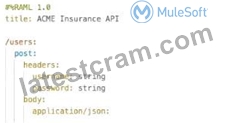
What is the correct way to create a user?
A)
B)
C)
D)
- A. Option A
- B. Option B
- C. Option D
- D. Option C
Answer: B
NEW QUESTION 66
Refer to the exhibit.
In the execution of the Scatter_Gather, the flow1 route completes after 10 seconds and the flow2 route completes after 20 seconds.
How many seconds does it take for the Scatter_Gather to complete?
- A. 0
- B. 1
- C. 2
- D. 3
Answer: D
NEW QUESTION 67
An API specification is designed using RAML. What is the next step to create a REST Connector from this API specification?
- A. Implement the API specification using flow designer in Design Center
- B. Download the API specification and build the interface using APIkit
- C. Publish the API specification to Any point Exchange
- D. Add the specification to a Mule project's src/main/resources/api folder
Answer: C
Explanation:
API Exchange creates REST conenctor automtaically once API is published. Hence correct answer is Publish the API specification to Any point Exchange
NEW QUESTION 68
Refer to the exhibit. The Batch Job processes, filters and aggregates records, What is the expected output from the Logger component?

- A. [10. 20, 30. 40, 50, 60]
- B. [10. 20] [30, 40] [50, 60]
- C. [20. 40] [60]
- D. [20, 40, 60]
Answer: C
NEW QUESTION 69
Refer to the exhibits.
Each route in the Scatter-Gather sets the payload to the number shown in the label. What response is returned to a web client request to the HTTP Listener?
A)
B)
C)
D)
- A. Option A
- B. Option D
- C. Option C
- D. Option B
Answer: B
NEW QUESTION 70
What path setting is required for an HTTP Listener endpoint to route all requests to an APIkit router?
- A. /
- B. /'
- C. /()
- D. /(*)
Answer: B
NEW QUESTION 71
Refer to the exhibit.
What can be added to the flow to persist data across different flow executions?
- A. properties of the Mule runtime app object
- B. Key/value pairs in the ObjectStore
- C. Properties of the Mule runtime flow object
- D. session variables
Answer: B
NEW QUESTION 72
Refer to the exhibits.

A JSON payload is set in the Set Payload transformer.
What is logged by the Logger?
- A. "JSON"
- B. "Object"
- C. "String"
- D. "Array"
Answer: D
NEW QUESTION 73
There are three routes configured for Scatter-Gather and incoming event has a payload is an Array of three objects. How routing will take place in this scenario?
- A. Entire event would be sent to each route in parallel
- B. Entire event would be sent to each route sequentially
- C. Incoming array objects would be split into three and each part would be sent to one route each in parallel
- D. Incoming array objects would be split into three and each part would be sent to one route each in sequential manner
Answer: A
Explanation:
Entire event would be sent to each route in parallel.
Scatter-Gather works as follows :
- The Scatter-Gather component receives a Mule event and sends a reference of this Mule event to each processing route.
- Each of the processing routes starts executing in parallel. After all processors inside a route finish processing, the route returns a Mule event, which can be either the same Mule event without modifications or a new Mule event created by the processors in the route as a result of the modifications applied.
- After all processing routes have finished execution, the Scatter-Gather component creates a new Mule event that combines all resulting Mule events from each route, and then passes the new Mule event to the next component in the flow.
NEW QUESTION 74
Which of the below activity doesn't support parallel execution?
- A. Batch job
- B. First Successful Router
- C. Scatter-Gather Router
- D. Parallel For Each
Answer: D
Explanation:
The First Successful router iterates through a list of configured processing routes until one of the routes executes successfully. This is sequential execution. In all other options mentioned in the question ,we can achieve parallel execution.
NEW QUESTION 75
Refer to the exhibits.
A web client submits a request to below flow. What is the output at the end of the flow?


- A. Object
- B. Java
- C. String
- D. XML
Answer: C
Explanation:
String is the correct answer as XML is of an Object type String
NEW QUESTION 76
Refer to the exhibit.
In the execution of the Scatter_Gather, the flow1 route completes after 10 seconds and the flow2 route completes after 20 seconds.
How many seconds does it take for the Scatter_Gather to complete?
- A. 0
- B. 1
- C. 2
- D. 3
Answer: D
NEW QUESTION 77
A Mule application's HTTP Listener is configured with the HTTP protocol. The HTTP listeners port attribute is configured with a property placeholder named http.port. The mule application sets the http.port property placeholder's value to 9090 The Mule application is deployed to CloudHub without setting any properties in the Runtime manager Properties tab and a log message reports the status of the HTTP listener after the Mule application deployment completes.
After the mule applications is deployed, what information is reported in the worker logs related to the port on which the Mule application's HTTP Listener listens?
- A. The HTTP Listener is listening on port 9090
- B. The HTTP Listener failed to bind to the port and is not listening for connections
- C. The HTTP Listener is listening on port 80
- D. The HTTP Listener is listening on port 8081
Answer: D
Explanation:
Cloudhub expose services on port 8081 and override value in http.port with this one .
Sample log in Runtime Manager is below
21:15:53.148 08/08/2021 Worker-0 ArtifactDeployer.start.01 INFO
Listening for connections on 'http://0.0.0.0:8081'
NEW QUESTION 78
A Mule project contains a DataWeave module called MyModule.dwl that defines a function named formatString. The module is located in the project's src/main/resources/modules folder.
What is the correct way in DataWeave code to import MyModule using a wildcard and then call the module's formatString function?
A)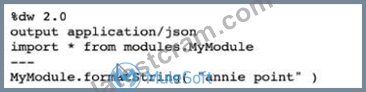
B)
C)
D)
- A. Option A
- B. Option D
- C. Option C
- D. Option B
Answer: B
NEW QUESTION 79
What HTTP method in a RESTful web service is typically used to completely replace an existing resource?
- A. GET
- B. POST
- C. PUT
- D. PATCH
Answer: C
Explanation:
PUT replaces the original version of the resource, whereas the PATCH method supplies a set of instructions to modify the resource
NEW QUESTION 80
Refer to the exhibit.

The main flow is configured with their error handlers. A web client submit a request to the HTTP Listener and the HTTP Request throws an HTTP:NOT_FOUND error.
What response message is returned?''
What response message is returned?
- A. other error
- B. HTTP: NOT FOUND
- C. APP: API RESOURCE NOT FOUND
- D. success - main flow
Answer: C
Explanation:
Correct answer is APP: API RESOURCE NOT FOUND
---------------------------------------------------------------------------------------------------------------------------------------------------
1) A web client submits the request to the HTTP Listener.
2) The HTTP Request throws an "HTTP:NOT_FOUND" error, execution halts.
3) The On Error Propagate error Handler handles the error. In this case ,HTTP:NOT_FOUND error is mapped to custom error APP:API_RESOURCE_NOT_FOUND. This error processor sets payload to APP:API_RESOURCE_NOT_FOUND.
4) "APP:API_RESOURCE_NOT_FOUND. " is the error message returned to the requestor in the body of the HTTP request with HTTP Status Code: 500 Reference Diagram:
NEW QUESTION 81
......
Verified MCD-Level-1 exam dumps Q&As with Correct 226 Questions and Answers: https://www.latestcram.com/MCD-Level-1-exam-cram-questions.html
