

The Best Practice Test Preparation for the CCST-Networking Certification Exam
CCST-Networking Exam Dumps, Practice Test Questions BUNDLE PACK
NEW QUESTION # 21
An engineer configured a new VLAN named VLAN2 for the Data Center team. When the teamtries to ping addresses outside VLAN2 from a computer in VLAN2, they are unable to reach them.
What should the engineer configure?
- A. Default route
- B. Additional VLAN
- C. Static route
- D. Default gateway
Answer: D
Explanation:
When devices within a VLAN are unable to reach addresses outside their VLAN, it typically indicates that they do not have a configured path to external networks. The engineer should configure a default gateway for VLAN2. The default gateway is the IP address of the router's interface that is connected to the VLAN, which will route traffic from the VLAN to other networks12.
References :=
*Understanding and Configuring VLAN Routing and Bridging on a Router Using the IRB Feature
*VLAN 2 not able to ping gateway - Cisco Community
*VLANs: Virtual Local Area Networks (VLANs) logically segment network traffic to improve security and performance. Devices within the same VLAN can communicate directly.
*Default Gateway: For devices in VLAN2 to communicate with devices outside their VLAN, they need a default gateway configured. The default gateway is typically a router or Layer 3 switch that routes traffic between different VLANs and subnets.
*Additional VLAN: Not needed in this scenario as the issue is related to routing traffic outside VLAN2, not creating another VLAN.
*Default Route: While a default route on the router may be necessary, the primary issue for devices within VLAN2 is to have a configured default gateway.
*Static Route: This is used on routers to manually specify routes to specific networks but does not address the need for a default gateway on the client devices.
References:
*Cisco VLAN Configuration Guide: Cisco VLAN Configuration
*Understanding and Configuring VLANs: VLANs Guide
NEW QUESTION # 22
What is the most compressed valid format of the IPv6 address 2001 :0db8:0000:0016:0000:001b: 2000:0056?
- A. 2001:db8: : 16: : 1b:2:56
- B. 2001:db8: : 16: : 1b: 2000: 56
- C. 2001:db8: 0:16: :1b: 2000:56
- D. 2001:db8: 16: :1b:2:56
Answer: C
Explanation:
IPv6 addresses can be compressed by removing leading zeros and replacing consecutive groups of zeros with a double colon (::). Here's how to compress the address 2001:0db8:0000:0016:0000:001b:2000:0056:
* Remove leading zeros from each segment:
* 2001:db8:0000:0016:0000:001b:2000:0056 becomes 2001:db8:0:16:0:1b:2000:56
* Replace the longest sequence of consecutive zeros with a double colon (::). In this case, the two consecutive zeros between the 16 and 1b:
* 2001:db8:0:16::1b:2000:56
Thus, the most compressed valid format of the IPv6 address is 2001:db8:0:16::1b:2000:56.
References:=
* Cisco Learning Network
* IPv6 Addressing (Cisco)
NEW QUESTION # 23
You need to connect a computer's network adapter to a switch using a 1000BASE-T cable.
Which connector should you use?
- A. OS2 LC
- B. RJ-45
- C. RJ-11
- D. Coax
Answer: B
Explanation:
*1000BASE-T Cable: This refers to Gigabit Ethernet over twisted-pair cables (Cat 5e or higher).
*Connector: RJ-45 connectors are used for Ethernet cables, including those used for 1000BASE-T.
*Coax: Used for cable TV and older Ethernet standards like 10BASE2.
*RJ-11: Used for telephone connections.
*OS2 LC: Used for fiber optic connections.
References:
*Ethernet Standards and Cables: Ethernet Cable Guide
NEW QUESTION # 24
Which device protects the network by permitting or denying traffic based on IP address, port number, or application?
- A. VPN gateway
- B. Intrusion detection system
- C. Firewall
- D. Access point
Answer: C
Explanation:
* Firewall: A firewall is a network security device that monitors and controls incoming and outgoing network traffic based on predetermined security rules. It permits or denies traffic based on IP addresses, port numbers, or applications.
* Access Point: This is a device that allows wireless devices to connect to a wired network using Wi-Fi. It does not perform traffic filtering based on IP, port, or application.
* VPN Gateway: This device allows for secure connections between networks over the internet, but it is not primarily used for traffic filtering based on IP, port, or application.
* Intrusion Detection System (IDS): This device monitors network traffic for suspicious activity and policy violations, but it does not actively permit or deny traffic.
References:
* Understanding Firewalls: Firewall Basics
NEW QUESTION # 25
A support technician examines the front panel of a Cisco switch and sees 4 Ethernet cables connected in the first four ports. Ports 1, 2, and 3 have a green LED. Port 4 has a blinking green light.
What is the state of the Port 4?
- A. Link is up with cable malfunctions.
- B. Link is up and not stable.
- C. Link is up and there is no activity.
- D. Link is up and active.
Answer: D
Explanation:
On a Cisco switch, a port with a blinking green LED typically indicates that the port is up (active) and is currently transmitting or receiving data. This is a normal state indicating active traffic on the port.
*A. Link is up with cable malfunctions: Usually indicated by an amber or blinking amber light.
*B. Link is up and not stable: Not typically indicated by a green blinking light.
*D. Link is up and there is no activity: Would be indicated by a solid green light withoutblinking.
Thus, the correct answer is C. Link is up and active.
References :=
*Cisco Switch LED Indicators
*Cisco Ethernet Switch LED Patterns
NEW QUESTION # 26
Move the MFA factors from the list on the left to their correct examples on the right. You may use each factor once, more than once, or not at all.
Note: You will receive partial credit for each correct selection.
Answer:
Explanation:
Explanation:
The correct matching of the MFA factors to their examples is as follows:
* Entering a one-time security code sent to your device after logging in: Possession
* Holding your phone to your face to be recognized: Inherence
* Specifying your user name and password to log on to a service: Knowledge Here's why each factor matches the example:
* Possession: This factor is something the user has, like a mobile device. A one-time security code sent to this device falls under this category.
* Inherence: This factor is something the user is, such as a biometric characteristic. Facial recognition using a phone is an example of this factor.
* Knowledge: This factor is something the user knows, like a password or PIN.
Multi-Factor Authentication (MFA) enhances security by requiring two or more of these factors to verify a user's identity before granting access.
* Entering a one-time security code sent to your device after logging in.
* Factor: Possession
* Explanation: This factor relates to something you have, such as a device that receives a security code.
* Holding your phone to your face to be recognized.
* Factor: Inference (typically referred to as Inherence or Biometric)
* Explanation: This factor relates to something you are, such as biometric authentication like facial recognition.
* Specifying your username and password to log on to a service.
* Factor: Knowledge
* Explanation: This factor relates to something you know, such as a username and password.
* Possession Factor: This involves something the user has in their possession. Receiving a one-time security code on a device (e.g., phone) is an example of this.
* Inference Factor (Inherence/Biometric): This involves something inherent to the user, such as biometric verification (e.g., facial recognition or fingerprint scanning).
* Knowledge Factor: This involves something the user knows, such as login credentials (username and password).
References:
* Multi-Factor Authentication (MFA) Explained: MFA Guide
* Understanding Authentication Factors: Authentication Factors
NEW QUESTION # 27
A Cisco PoE switch is shown in the following image. Which type of port will provide both data connectivity and power to an IP phone?
- A. Ports identified with number 7
- B. Port identified with number 2
- C. Ports identified with number 6
- D. Ports identified with numbers 3 and 4
Answer: C
Explanation:
In the provided image of the Cisco PoE switch, the ports identified with number 6 are the standard RJ-45 Ethernet ports typically found on switches that provide both data connectivity and Power over Ethernet (PoE).
PoE ports are designed to supply power to devices such as IP phones, wireless access points, and other PoE-enabled devices directly through the Ethernet cable.
Ports:
*2: Console port (for management and configuration)
*3 and 4: Specific function ports (often for management)
*6: RJ-45 Ethernet ports (capable of providing PoE)
*7: SFP ports (for fiber connections, typically do not provide PoE)
Thus, the correct answer is C. Ports identified with number 6.
References :=
*Cisco Catalyst 2960-L Series Switches Data Sheet
*Cisco PoE Overview
NEW QUESTION # 28
You plan to use a network firewall to protect computers at a small office.
For each statement about firewalls, select True or False.
Note: You will receive partial credit for each correct selection.
Answer:
Explanation:
Explanation:
* A firewall can direct all web traffic to a specific IP address.
* True: Firewalls can be configured to perform Network Address Translation (NAT) and port forwarding, which can direct all web traffic (typically on port 80 and 443) to a specific internal IP address.
* A firewall can block traffic to specific ports on internal computers.
* True: Firewalls can be configured with access control lists (ACLs) or rules to block traffic to specific ports on internal computers, enhancing security by restricting unwanted or harmful traffic.
* A firewall can prevent specific apps from running on a computer.
* False: Firewalls typically control traffic flow and do not prevent specific applications from running on a computer. Application control is usually managed by endpoint security software or application control systems.
* Directing Web Traffic: Firewalls can manage traffic redirection using NAT and port forwarding rules to route web traffic to designated servers or devices within the network.
* Blocking Specific Ports: Firewalls can enforce security policies by blocking or allowing traffic based on port numbers, ensuring that only permitted traffic reaches internal systems.
* Application Control: While firewalls manage network traffic, preventing applications from running typically requires software specifically designed for endpoint protection and application management.
References:
* Understanding Firewalls: Firewall Capabilities
* Network Security Best Practices: Network Security Guide
NEW QUESTION # 29
A help desk technician receives the four trouble tickets listed below. Which ticket should receive the highest priority and be addressed first?
- A. Ticket 4: Two users report that wireless access in the cafeteria has been down for the last hour.
- B. Ticket 3: A user reports that response time for a cloud-based application is slower than usual.
- C. Ticket 1: A user requests relocation of a printer to a different network jack in the same office. The jack must be patched and made active.
- D. Ticket 2: An online webinar is taking place in the conference room. The video conferencing equipment lost internet access.
Answer: D
Explanation:
When prioritizing trouble tickets, the most critical issues affecting business operations or high-impact activities should be addressed first. Here's a breakdown of the tickets:
* Ticket 1: Relocation of a printer, while necessary, is not urgent and does not impact critical operations.
* Ticket 2: An ongoing webinar losing internet access is critical, especially if the webinar is time-sensitive and involves multiple participants.
* Ticket 3: Slower response time for a cloud-based application is important but typically not as urgent as a complete loss of internet access for a live event.
* Ticket 4: Wireless access down in the cafeteria affects users but does not have the same immediate impact as a live webinar losing connectivity.
Thus, the correct answer is B. Ticket 2: An online webinar is taking place in the conference room. The video conferencing equipment lost internet access.
References:=
* IT Help Desk Best Practices
* Prioritizing IT Support Tickets
NEW QUESTION # 30
For each statement about bandwidth and throughput, select True or False.
Note: You will receive partial credit for each correct selection.
Answer:
Explanation:
Explanation:
* Statement 1: Low bandwidth can increase network latency.
* True: Low bandwidth can result in increased network latency because the network may become congested, leading to delays in data transmission.
* Statement 2: High levels of network latency decrease network bandwidth.
* False: High levels of network latency do not decrease the available network bandwidth, but they do affect the perceived performance and throughput of the network.
* Statement 3: You can increase throughput by decreasing network latency.
* True: Decreasing network latency can increase throughput because data can be transmitted more quickly and efficiently without delays.
* Bandwidth vs. Latency: Bandwidth refers to the maximum rate at which data can be transferred over a network path. Latency is the time it takes for a data packet to travel from the source to the destination.
* Low bandwidth can cause network congestion, which can increase latency as packets wait to be transmitted.
* High latency does not reduce the actual bandwidth but can affect the overall performance and efficiency of data transmission.
* Reducing latency can lead to higher throughput because the network can handle more data in a given period without delays.
References:
* Network Performance Metrics: Cisco Network Performance
* Understanding Bandwidth and Latency: Bandwidth vs. Latency
NEW QUESTION # 31
Which two statements are true about the IPv4 address of the default gateway configured on a host? (Choose 2.) Note: You will receive partial credit for each correct selection.
- A. Hosts learn the default gateway IPv4 address through router advertisement messages.
- B. The IPv4 address of the default gateway must be the first host address in the subnet.
- C. The default gateway is the IPv4 address of the router interface connected to the same local network as the host.
- D. The default gateway is the Loopback0 interface IPv4 address of the router connected to the same local network as the host.
- E. The same default gateway IPv4 address is configured on each host on the local network.
Answer: C,E
Explanation:
*Statement B: "The same default gateway IPv4 address is configured on each host on the local network." This is true because all hosts on the same local network (subnet) use the same default gateway IP address to send packets destined for other networks.
*Statement D: "The default gateway is the IPv4 address of the router interface connected to the same local network as the host." This is true because the default gateway is the IP address of the router's interface that is directly connected to the local network.
*Statement A: "The IPv4 address of the default gateway must be the first host address in the subnet." This is not necessarily true. The default gateway can be any address within the subnet range.
*Statement C: "The default gateway is the Loopback0 interface IPv4 address of the router connected to the same local network as the host." This is not true; the default gateway is the IP address of the router's physical or logical interface connected to the local network.
*Statement E: "Hosts learn the default gateway IPv4 address through router advertisement messages." This is generally true for IPv6 with Router Advertisement (RA) messages, but not typically how IPv4 hosts learn the default gateway address.
References:
*Cisco Default Gateway Configuration: Cisco Default Gateway
NEW QUESTION # 32
Move the security options from the list on the left to its characteristic on the right. You may use each security option once, more than once, or not at all.
Note: You will receive partial credit for each correct answer.
Answer:
Explanation:
Explanation:
The correct matching of the security options to their characteristics is as follows:
* WPA2-Enterprise: Uses a RADIUS server for authentication
* WEP: Uses a minimum of 40 bits for encryption
* WPA2-Personal: Uses AES and a pre-shared key for authentication
Here's why each security option matches the characteristic:
* WPA2-Enterpriseuses a RADIUS server for authentication, which provides centralized Authentication, Authorization, and Accounting (AAA) management for users who connect and use a network service.
* WEP (Wired Equivalent Privacy)is an outdated security protocol that uses a minimum of 40 bits for encryption (and up to 104 bits), which is relatively weak by today's standards.
* WPA2-Personal(Wi-Fi Protected Access 2 - Personal) uses the Advanced Encryption Standard (AES) for encryption and a pre-shared key (PSK) for authentication, which is shared among users to access the network.
These security options are essential for protecting wireless networks from unauthorized access and ensuring data privacy.
NEW QUESTION # 33
During the data encapsulation process, which OSI layer adds a header that contains MAC addressing information and a trailer used for error checking?
- A. Session
- B. Transport
- C. Data Link
- D. Network
Answer: C
Explanation:
OSI model
During the data encapsulation process, theData Link layerof the OSI model is responsible for adding a header that contains MAC addressing information and a trailer used for error checking.The header typically includes the source and destination MAC addresses, while the trailer contains a Frame Check Sequence (FCS) which is used for error detection1.
The Data Link layer ensures that messages are delivered to the proper device on a LAN using hardware addresses and translates messages from the Network layer into bits for the Physical layer to transmit. It also controls how data is placed onto the medium and is received from the medium through the physical hardware.
References:=
* The OSI Model - The 7 Layers of Networking Explained in Plain English
* OSI Model - Network Direction
* Which layer adds both header and trailer to the data?
* What is OSI Model | 7 Layers Explained - GeeksforGeeks
NEW QUESTION # 34
Move each cloud computing service model from the list on the left to the correct example on the right Note: You will receive partial credit for each correct answer.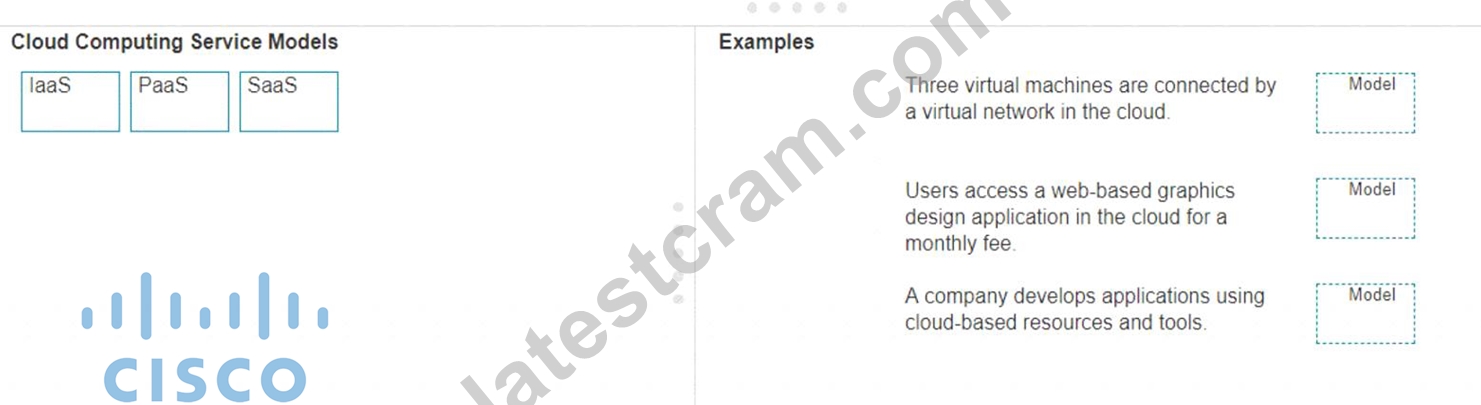
Answer:
Explanation:
Explanation:
* Three virtual machines are connected by a virtual network in the cloud.
* Model: IaaS (Infrastructure as a Service)
* Explanation: IaaS provides virtualized computing resources over the internet, including virtual machines, storage, and networks.
* Users access a web-based graphics design application in the cloud for a monthly fee.
* Model: SaaS (Software as a Service)
* Explanation: SaaS delivers software applications over the internet, typically on a subscription basis, accessible via a web browser.
* A company develops applications using cloud-based resources and tools.
* Model: PaaS (Platform as a Service)
* Explanation: PaaS provides a platform allowing customers to develop, run, and manage applications without dealing with the infrastructure.
* IaaS (Infrastructure as a Service): Provides virtualized hardware resources that customers can use to build their own computing environments.
* PaaS (Platform as a Service): Offers a platform with tools and services to develop, test, and deploy applications.
* SaaS (Software as a Service): Delivers fully functional applications over the internet that users can access and use without managing the underlying infrastructure.
References:
* Cloud Service Models: Understanding IaaS, PaaS, SaaS
* NIST Definition of Cloud Computing:NIST Cloud Computing
NEW QUESTION # 35
Move each network type from the list on the left to the correct example on the right.
Answer:
Explanation:
Explanation:
* Two home office computers are connected to a switch by Ethernet cables.
* Network Type: LAN (Local Area Network)
* Explanation: A LAN connects devices within a limited area such as a home, office, or building, using Ethernet cables or Wi-Fi.
* Three government buildings in the same city connect to a cable company over coaxial cables.
* Network Type: MAN (Metropolitan Area Network)
* Explanation: A MAN connects networks across a city or campus, often using fiber optic or coaxial cables.
* A cell phone connects to a Bluetooth headset.
* Network Type: PAN (Personal Area Network)
* Explanation: A PAN connects devices within a personal workspace, typically using wireless technologies like Bluetooth.
* A financial institution connects its branches through a telecommunications service provider.
* Network Type: WAN (Wide Area Network)
* Explanation: A WAN connects multiple LANs over long distances, often using leased lines or satellite links provided by telecommunications companies.
* LAN (Local Area Network): Used for connecting devices within a small geographical area such as a
* single building or home.
* MAN (Metropolitan Area Network): Covers a larger geographical area than a LAN, typically a city or campus.
* PAN (Personal Area Network): Connects devices within the range of an individual person, such as connecting a phone to a Bluetooth headset.
* WAN (Wide Area Network): Spans large geographical areas, connecting multiple LANs across cities, countries, or continents.
References:
* Network Types Overview: Cisco Networking Basics
* Understanding Different Network Types: Network Types Guide
NEW QUESTION # 36
......
Prepare for the Actual CCST CCST-Networking Exam Practice Materials Collection: https://www.latestcram.com/CCST-Networking-exam-cram-questions.html
CCST Certification CCST-Networking Sample Questions Reliable: https://drive.google.com/open?id=1xZun1t3G4-_gyaca6gyaE5HdAFX398cG
