

Prepare Top MuleSoft MCIA-Level-1 Exam Study Guide Practice Questions Edition
Go to MCIA-Level-1 Questions - Try MCIA-Level-1 dumps pdf
NEW QUESTION 40
Refer to the exhibit.
An organization deploys multiple Mule applications to the same customer -hosted Mule runtime. Many of these Mule applications must expose an HTTPS endpoint on the same port using a server-side certificate that rotates often.
What is the most effective way to package the HTTP Listener and package or store the server-side certificate when deploying these Mule applications, so the disruption caused by certificate rotation is minimized?
- A. Package an HTTPS Listener configuration In all Mule APPLICATIONS that need to expose an HTTPS endpoint Package the server-side certificate in a NEW Mule DOMAIN project
- B. Package the HTTPS Listener configuration in a Mule DOMAIN project, referencing it from all Mule applications that need to expose an HTTPS endpoint Package the server-side certificate in ALL Mule APPLICATIONS that need to expose an HTTPS endpoint
- C. Package the HTTPS Listener configuration in a Mule DOMAIN project, referencing it from all Mule applications that need to expose an HTTPS endpoint. Store the server-side certificate in a shared filesystem location in the Mule runtime's classpath, OUTSIDE the Mule DOMAIN or any Mule APPLICATION
- D. Package the HTTPS Listener configuration in a Mule DOMAIN project, referencing It from all Mule applications that need to expose an HTTPS endpoint. Package the server-side certificate in the SAME Mule DOMAIN project Go to Set
Answer: C
NEW QUESTION 41
Additional nodes are being added to an existing customer-hosted Mule runtime cluster to improve performance. Mule applications deployed to this cluster are invoked by API clients through a load balancer.
What is also required to carry out this change?
- A. API implementations using an object store must be adjusted to recognize the new nodes and persist to them
- B. A new load balancer must be provisioned to allow traffic to the new nodes in a round-robin fashion
- C. External monitoring tools or log aggregators must be configured to recognize the new nodes
- D. New firewall rules must be configured to accommodate communication between API clients and the new nodes
Answer: C
NEW QUESTION 42
A popular retailer is designing a public API for its numerous business partners. Each business partner will invoke the API at the URL https://api.acme.com/partners/v1. The API implementation is estimated to require deployment to 5 CloudHub workers.
The retailer has obtained a public X.509 certificate for the name api.acme.com, signed by a reputable CA, to be used as the server certificate.
Where and how should the X.509 certificate and Mule applications be used to configure load balancing among the 5 CloudHub workers, and what DNS entries should be configured in order for the retailer to support its numerous business partners?
- A. Add the X.509 certificate to a CloudHub Dedicated Load Balancer (DLB), not to the Mule application Create a CNAME for api.acme.com pointing to the DLB's A record
- B. Add the X.509 certificate to the CloudHub Shared Load Balancer (SLB), not to the Mule application Create a CNAME for api.acme.com pointing to the SLB's A record
- C. Add the X.509 certificate to the Mule application's deployable archive, then configure a CloudHub Dedicated Load Balancer (DLB) for each of the Mule application's CloudHub workers Create a CNAME for api.acme.com pointing to the DLB's A record
- D. Add the X.509 certificate to the Mule application's deployable archive, then configure the CloudHub Shared Load Balancer (SLB) for each of the Mule application's CloudHub workers Create a CNAME for api.acme.com pointing to the SLB's A record
Answer: B
NEW QUESTION 43
Refer to the exhibit. This Mule application is deployed to multiple CloudHub workers with persistent queues enabled.
The retrieveFile flow's event source reads a CSV file from a remote SFTP server and then publishes each record in the CSV file to a VM queue.
The processCustomerRecords flow's VM Listener receives messages from the same VM queue and then processes each message separately.
How are messages routed to the CloudHub workers as messages are received by the VM Listener?
- A. Each message is duplicated to ALL of the CloudHub workers, thereby SHARING EACH message with ALL the CloudHub workers
- B. Each message is routed to the SAME CloudHub worker that retrieved the file, thereby BINDING ALL messages to ONLY that ONE CloudHub worker
- C. Each message is routed to ONE of the CloudHub workers in a DETERMINISTIC round-robin fashion, thereby EXACTLY BALANCING messages among the CloudHub workers
- D. Each message is routed to ONE of the available CloudHub workers in a NON-DETERMINISTIC non-round- robin fashion, thereby APPROXIMATELY BALANCING messages among the CloudHub workers
Answer: D
NEW QUESTION 44
Refer to the exhibit. A business process involves two APIs that interact with each other asynchronously over HTTP. Each API is implemented as a Mule application. API 1 receives the initial HTTP request and invokes API 2 (in a fire and forget fashion) while API 2, upon completion of the processing, calls back into API 1 to notify about completion of the asynchronous process.
Each API is deployed to multiple redundant Mule runtimes and a separate load balancer, and is deployed to a separate network zone.
In the network architecture, how must the firewall rules be configured to enable the above interaction between API 1 and API 2?

- A. To allow communication between the load balancers used by each API
- B. To authorize the certificates used by both the APIs
- C. To enable communication from each API's Mule runtimes and network zone to the load balancer of the other API
- D. To open direct two-way communication between the Mule runtimes of both APIs
Answer: D
NEW QUESTION 45
An organization uses a four(4) node customer hosted Mule runtime cluster to host one(1) stateless api implementation. The API is accessed over HTTPS through a load balancer that uses round-robin for load distribution. Each node in the cluster has been sized to be able to accept four(4) times the current number of requests.
Two(2) nodes in the cluster experience a power outage and are no longer available. The load balancer directs the outage and blocks the two unavailable the nodes from receiving further HTTP requests.
What performance-related consequence is guaranteed to happen to average, assuming the remaining cluster nodes are fully operational?
- A. 50% reduction in the throughput of the API
- B. 100% increase in the number of requests received by each remaining node
- C. 50% increase in the JVM heap memory consumed by each remaining node
- D. 100% increase in the average response time of the API
Answer: D
NEW QUESTION 46
What operation can be performed through a JMX agent enabled in a Mule application?
- A. View object store entries
- B. Replay an unsuccessful message
- C. Set a particular tog4J2 log level to TRACE
- D. Deploy a Mule application
Answer: D
NEW QUESTION 47
Refer to the exhibit.
A Mule application is deployed to a multi-node Mule runtime cluster. The Mule application uses the competing consumer pattern among its cluster replicas to receive JMS messages from a JMS queue. To process each received JMS message, the following steps are performed in a flow:
Step l: The JMS Correlation ID header is read from the received JMS message.
Step 2: The Mule application invokes an idempotent SOAP webservice over HTTPS, passing the JMS Correlation ID as one parameter in the SOAP request.
Step 3: The response from the SOAP webservice also returns the same JMS Correlation ID.
Step 4: The JMS Correlation ID received from the SOAP webservice is validated to be identical to the JMS Correlation ID received in Step 1.
Step 5: The Mule application creates a response JMS message, setting the JMS Correlation ID message header to the validated JMS Correlation ID and publishes that message to a response JMS queue.
Where should the Mule application store the JMS Correlation ID values received in Step 1 and Step 3 so that the validation in Step 4 can be performed, while also making the overall Mule application highly available, fault-tolerant, performant, and maintainable?
- A. Both Correlation ID values should be stored in a persistent object store
- B. The Correlation ID value in Step 1 should be stored in a persistent object store The Correlation ID value in step 3 should be stored as a Mule event vanable/attnbute
- C. Both Correlation ID values should be stored In a non-persistent object store
- D. Both Correlation ID values should be stored as Mule event vanabtes/attnbutes
Answer: B
NEW QUESTION 48
An integration Mule application is deployed to a customer-hosted multi-node Mule 4 runtime duster. The Mule application uses a Listener operation of a JMS connector to receive incoming messages from a JMS queue.
How are the messages consumed by the Mule application?
- A. Depending on the JMS provider's configuration, either all messages are consumed by ONLY the primary cluster node or else ALL messages are consumed by ALL cluster nodes
- B. Depending on the Listener operation configuration, either all messages are consumed by ONLY the primary cluster node or else EACH message is consumed by ANY ONE cluster node
- C. Regardless of the Listener operation configuration, all messages are consumed by ONLY the primary cluster node
- D. Regardless of the Listener operation configuration, all messages are consumed by ALL cluster nodes
Answer: B
NEW QUESTION 49
An organization uses a four(4) node customer hosted Mule runtime cluster to host one(1) stateless api implementation. The API is accessed over HTTPS through a load balancer that uses round-robin for load distribution. Each node in the cluster has been sized to be able to accept four(4) times the current number of requests.
Two(2) nodes in the cluster experience a power outage and are no longer available. The load balancer directs the outage and blocks the two unavailable the nodes from receiving further HTTP requests.
What performance-related consequence is guaranteed to happen to average, assuming the remaining cluster nodes are fully operational?
- A. 50% increase in the JVM heap memory consumed by each remaining node
- B. 50% reduction in the throughput of the API
- C. 100% increase in the number of requests received by each remaining node
- D. 100% increase in the average response time of the API
Answer: A
NEW QUESTION 50
Refer to the exhibit. An organization is designing a Mule application to receive data from one external business partner. The two companies currently have no shared IT infrastructure and do not want to establish one. Instead, all communication should be over the public internet (with no VPN).
What Anypoint Connector can be used in the organization's Mule application to securely receive data from this external business partner?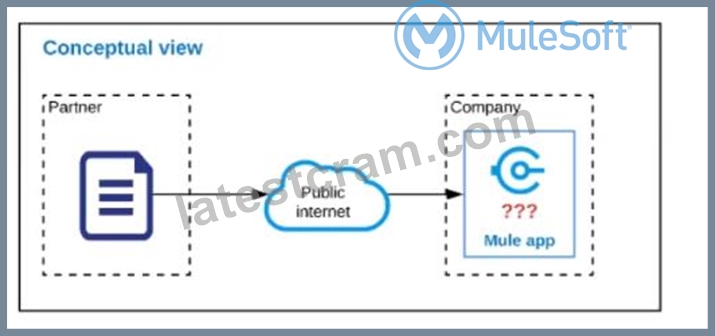
- A. VM connector
- B. File connector
- C. Object Store connector
- D. SFTP connector
Answer: D
NEW QUESTION 51
Refer to the exhibit. A Mule application is deployed to a multi-node Mule runtime cluster. The Mule application uses the competing consumer pattern among its cluster replicas to receive JMS messages from a JMS queue.
To process each received JMS message, the following steps are performed in a flow:
Step 1: The JMS Correlation ID header is read from the received JMS message.
Step 2: The Mule application invokes an idempotent SOAP webservice over HTTPS, passing the JMS Correlation ID as one parameter in the SOAP request.
Step 3: The response from the SOAP webservice also returns the same JMS Correlation ID.
Step 4: The JMS Correlation ID received from the SOAP webservice is validated to be identical to the JMS Correlation ID received in Step 1.
Step 5: The Mule application creates a response JMS message, setting the JMS Correlation ID message header to the validated JMS Correlation ID and publishes that message to a response JMS queue.
Where should the Mule application store the JMS Correlation ID values received in Step 1 and Step 3 so that the validation in Step 4 can be performed, while also making the overall Mule application highly available, fault- tolerant, performant, and maintainable?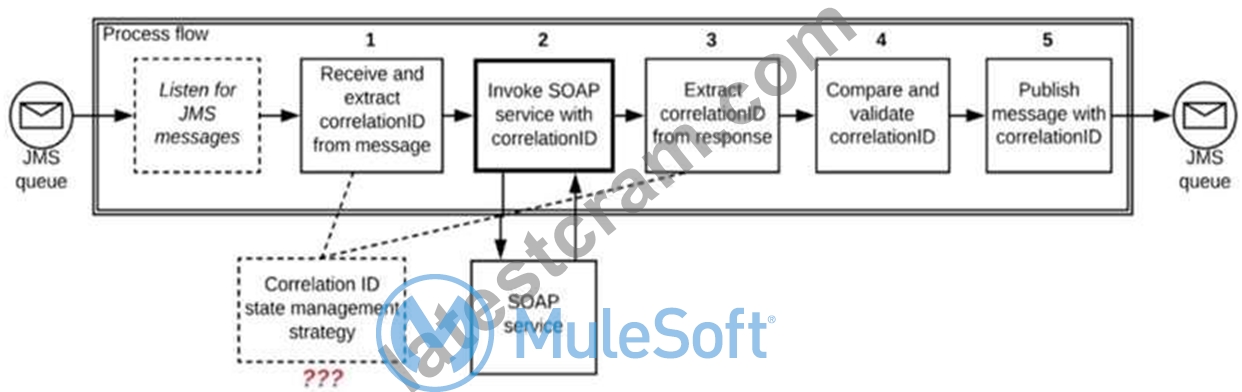
- A. The Correlation ID value in Step 1 should be stored in a persistent object store The Correlation ID value in Step 3 should be stored as a Mule event variable/attribute
- B. Both Correlation ID values should be stored in a persistent object store
- C. Both Correlation ID values should be stored in a non-persistent object store
- D. Both Correlation ID values should be stored as Mule event variables/attributes
Answer: A
NEW QUESTION 52
Refer to the exhibit.
A shopping cart checkout process consists of a web store backend sending a sequence of API invocations to an Experience API, which in turn invokes a Process API. All API invocations are over HTTPS POST. The Java web store backend executes in a Java EE application server, while all API implementations are Mule applications executing in a customer -hosted Mule runtime.
End-to-end correlation of all HTTP requests and responses belonging to each individual checkout Instance is required. This is to be done through a common correlation ID, so that all log entries written by the web store backend, Experience API implementation, and Process API implementation include the same correlation ID for all requests and responses belonging to the same checkout instance.
What is the most efficient way (using the least amount of custom coding or configuration) for the web store backend and the implementations of the Experience API and Process API to participate in end-to-end correlation of the API invocations for each checkout instance?
A)
The web store backend, being a Java EE application, automatically makes use of the thread-local correlation ID generated by the Java EE application server and automatically transmits that to the Experience API using HTTP-standard headers No special code or configuration is included in the web store backend, Experience API, and Process API implementations to generate and manage the correlation ID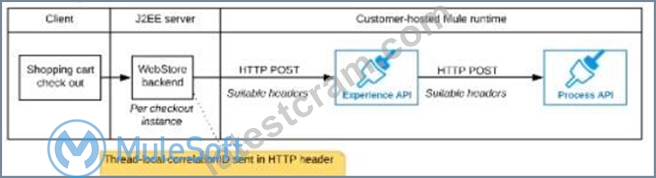
B)
The web store backend generates a new correlation ID value at the start of checkout and sets it on the X-CORRELATlON-lt HTTP request header In each API invocation belonging to that checkout No special code or configuration is included in the Experience API and Process API implementations to generate and manage the correlation ID
C)
The Experience API implementation generates a correlation ID for each incoming HTTP request and passes it to the web store backend in the HTTP response, which includes it in all subsequent API invocations to the Experience API.
The Experience API implementation must be coded to also propagate the correlation ID to the Process API in a suitable HTTP request header
D)
The web store backend sends a correlation ID value in the HTTP request body In the way required by the Experience API The Experience API and Process API implementations must be coded to receive the custom correlation ID In the HTTP requests and propagate It in suitable HTTP request headers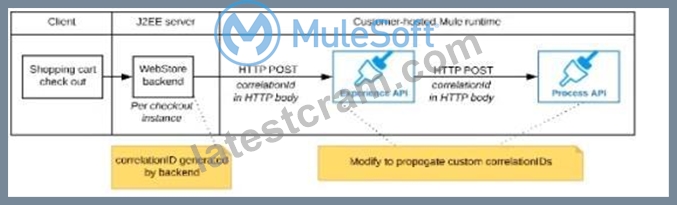
- A. Option D
- B. Option A
- C. Option C
- D. Option B
Answer: D
NEW QUESTION 53
A Mule application currently writes to two separate SQL Server database instances across the internet using a single XA transaction. It is proposed to split this one transaction into two separate non-XA transactions with no other changes to the Mule application.
What non-functional requirement can be expected to be negatively affected when implementing this change?
- A. Availability
- B. Consistency
- C. Throughput
- D. Response time
Answer: B
NEW QUESTION 54
In a Mule Application, a flow contains two (2) JMS consume operations that are used to connect to a JMS broker and consume messages from two(2) JMS destination. The Mule application then joins the two JMS messages together.
The JMS broker does not implement high availability (HA) and periodically experiences scheduled outages of upto 10 mins for routine maintenance.
What is the most idiomatic (used for its intented purpose) way to build the mule flow so it can best recover from the expected outages?
- A. Consider a transaction for the JMS connector
- B. Enclose the two(2) JMS operation in an Until Successful scope
- C. Configure a reconnection strategy for the JMS connector
- D. Enclose the two(2) JMS operations in a Try scope with an Error Continue error handler
Answer: C
NEW QUESTION 55
What is true about the network connections when a Mule application uses a JMS connector to interact with a JMS provider (message broker)?
- A. To complete sending a JMS message, the JMS connector must establish a network connection with the JMS message recipient
- B. The AMQP protocol can be used by the JMS connector to portably establish connections to various types of JMS providers
- C. The JMS connector supports both sending and receiving of JMS messages over the protocol determined by the JMS provider
- D. To receive messages into the Mule application, the JMS provider initiates a network connection to the JMS connector and pushes messages along this connection
Answer: A
NEW QUESTION 56
An organization is designing a mule application to support an all or nothing transaction between serval database operations and some other connectors so that they all roll back if there is a problem with any of the connectors Besides the database connector , what other connector can be used in the transaction.
- A. VM
- B. ObjectStore
- C. SFTP
- D. Anypoint MQ
Answer: C
NEW QUESTION 57
Refer to the exhibit.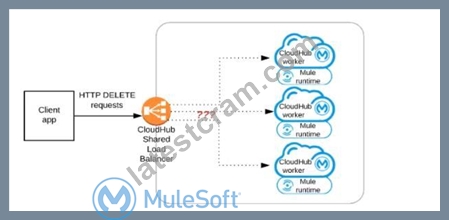
A Mule application has an HTTP Listener that accepts HTTP DELETE requests. This Mule application Is deployed to three CloudHub workers under the control of the CloudHub Shared Load Balancer.
A web client makes a sequence of requests to the Mule application's public URL.
How is this sequence of web client requests distributed among the HTTP Listeners running in the three CloudHub workers?
- A. Each request is routed (scattered) to ALL three CloudHub workers at the same time
- B. Each request Is routed to ONE ARBiTRARY CloudHub worker out of ALL three CloudHub workers
- C. Each request is routed to the PRIMARY CloudHub worker in the PRIMARY Availability Zone (AZ)
- D. Each request is routed to ONE ARBiTRARY CloudHub worker in the PRIMARY Availability Zone (AZ)
Answer: B
NEW QUESTION 58
Refer to the exhibit.
A Mule application is deployed to a cluster of two customer-hosted Mute runtimes. The Mute application has a flow that polls a database and another flow with an HTTP Listener.
HTTP clients send HTTP requests directly to individual cluster nodes.
What happens to database polling and HTTP request handling in the time after the primary (master) node of the cluster has railed, but before that node is restarted?
- A. Database polling stops All HTTP requests continue to be accepted
- B. Database polling stops All HTTP requests are rejected
- C. Database polling continues All HTTP requests continue to be accepted, but requests to the failed node Incur increased latency
- D. Database polling continues Only HTTP requests sent to the remaining node continue to be accepted
Answer: D
NEW QUESTION 59
......
How to Prepare For MuleSoft mcia - Level 1: MuleSoft Certified Integration Architect - Level 1 Exam
Preparation Guide for MuleSoft mcia - Level 1: MuleSoft Certified Integration Architect - Level 1 Exam
Introduction
MuleSoft has a unique community. Individuals can go ahead and appear for certification which they find suitable as per their expertise and skillset. MuleSoft also recognizes that the community is an important way to engage with its customer base.
Certification is evidence of your skills, expertise in those areas in which you like to work. If a candidate wants to work on MuleSoft mcia - Level 1: MuleSoft Certified Integration Architect - Level 1 and prove his knowledge, Certification offered by MuleSoft. This MuleSoft mcia - Level 1: MuleSoft Certified Integration Architect - Level 1 Individuals Qualification Certification helps a candidate to validates his skills in MuleSoft mcia - Level 1: MuleSoft Certified Integration Architect - Level 1. In this guide, we will cover mcia-level-1 practice exams and all the aspects of mcia-level-1 dumps.
Free MuleSoft Certified Architect MCIA-Level-1 Exam Question: https://www.latestcram.com/MCIA-Level-1-exam-cram-questions.html
