

[Nov-2021] DP-300 Exam Dumps - Free Demo & 365 Day Updates
Free Sales Ending Soon - Use Real DP-300 PDF Questions
Exam Topics
The Microsoft DP-300 exam measures the capability of the candidates to complete certain technical tasks, such as querying performance, planning and implementing the High Availability & Disaster Recovery environment, and optimizing & monitoring operational resources. The highlights of these topics are as follows:
- Use of T-SQL in Administration Performance: 10-15%
Within this module, the individuals should be able to evaluate system health and use T-SQL to monitor the configuration of database. It will evaluate their skills in performing backup and database restoration with the use of T-SQL, as well as managing authentication and authorization utilizing T-SQL.
- Secure Environment Implementation: 15-20%
This topic will evaluate the capability of the candidates to use database tools and platforms to configure the authentication and authorization of database. It will also measure the skills required to implement the security for data on rest. Additionally, the individuals should develop their expertise in implementing security for data on transit and compliance controls for delicate data.
- Data Platform Resources Planning and Implementation: 15-20%
The applicants should have the ability to deploy resources with the use of manual methods. They should also be able to recommend the relevant database contributions based on certain prerequisites. The examinees will be measured based on their competence in configuring resources for performance and scale; evaluating strategies for movement to Azure. They also need the knowledge of upgrade or migration strategy implementation to move to Azure.
- Operational Resources Optimization and Monitoring: 15-20%
The test takers need the relevant skills in managing performance and activity, identifying issues related to performance, and implementing maintenance tasks that are related to performance. This section of the exam also requires that they demonstrate their expertise in configuring resources and user databases for optimum performance.
- Tasks Automation Performance: 10-15%
The examinees should have the capacity to develop scheduled tasks, measure and execute notification and alert strategies, and automate and manage tasks within Azure. This part will test their skills in managing schedules for different maintenance jobs, automating backups, and creating alerts for the server configuration changes.
- HADR Planning and Implementation: 15-20%
This domain requires that the candidates have the ability to recommend High Availability & Disaster Recovery (HADR) strategies for data platform solutions. It also covers the skills in testing HADR strategies with the use of database tools, platforms, and operating systems. The subject area will also evaluate one’s expertise in performing the backup and restoration of a database with the use of database tools. It will also measure the ability to configure High Availability & Disaster Recovery with the use of platform, database tools, and OS.
- Query Performance Optimization: 5-10%
This knowledge area of the exam will test the ability of the students to evaluate performance optimization, evaluate query plans, and review index design and database table. This covers their competence in identifying issues with data quality based on duplication of data; evaluating a strategy for table partitioning; evaluating index design for optimal performance.
Administration tasks with the use of T-SQL
- System health assessment
- Utilizing DBCC for database consistency checks
- The use of DMVs for examining health of servers and databases
- Monitoring of database configuration
- The configuration of database autogrowth
- Reviewing options for database configuration
- Database free space reports
- Management of authorization and authentication
- Handling security principals and certificates
- The configuration of permissions
- Using T-SQL for restoration and backups
- Performing database backups and transaction log backups
- Restoring user databases
- Always On Availability Groups and preparing databases for them
NEW QUESTION 16
DRAG DROP
You have a resource group named App1Dev that contains an Azure SQL Database server named DevServer1.
DevServer1 contains an Azure SQL database named DB1. The schema and permissions for DB1 are saved in
a Microsoft SQL Server Data Tools (SSDT) database project.
You need to populate a new resource group named App1Test with the DB1 database and an Azure SQL Server
named TestServer1. The resources in App1Test must have the same configurations as the resources in
App1Dev.
Which four actions should you perform in sequence? To answer, move the appropriate actions from the list of
actions to the answer area and arrange them in the correct order.
Select and Place:
Answer:
Explanation:
Section: [none]
NEW QUESTION 17
You have an Azure Synapse Analytics dedicated SQL pool named Pool1 and an Azure Data Lake Storage Gen2 account named Account1.
You plan to access the files in Account1 by using an external table.
You need to create a data source in Pool1 that you can reference when you create the external table.
How should you complete the Transact-SQL statement? To answer, select the appropriate options in the answer area.
NOTE: Each correct selection is worth one point.
Answer:
Explanation:
Reference:
https://docs.microsoft.com/en-us/azure/synapse-analytics/sql/develop-tables-external-tables
NEW QUESTION 18
You are evaluating the role assignments.
For each of the following statements, select Yes if the statement is true. Otherwise, select No.
NOTE: Each correct selection is worth one point.
Answer:
Explanation:
Reference:
https://docs.microsoft.com/en-us/azure/role-based-access-control/built-in-roles
NEW QUESTION 19
HOTSPOT
You have an Azure Data Factory instance named ADF1 and two Azure Synapse Analytics workspaces named WS1 and WS2.
ADF1 contains the following pipelines:
* P1:Uses a copy activity to copy data from a nonpartitioned table in a dedicated SQL pool of WS1 to an Azure Data Lake Storage Gen2 account
* P2:Uses a copy activity to copy data from text-delimited files in an Azure Data Lake Storage Gen2 account to a nonpartitioned table in a dedicated SQL pool of WS2 You need to configure P1 and P2 to maximize parallelism and performance.
Which dataset settings should you configure for the copy activity of each pipeline? To answer, select the appropriate options in the answer area.
Hot Area:
Answer:
Explanation:
Section: [none]
Explanation:
P1: Set the Partition option to Dynamic Range.
The SQL Server connector in copy activity provides built-in data partitioning to copy data in parallel.
P2: Set the Copy method to PolyBase
Polybase is the most efficient way to move data into Azure Synapse Analytics. Use the staging blob feature to achieve high load speeds from all types of data stores, including Azure Blob storage and Data Lake Store.
(Polybase supports Azure Blob storage and Azure Data Lake Store by default.) Reference:
https://docs.microsoft.com/en-us/azure/data-factory/connector-azure-sql-data-warehouse
https://docs.microsoft.com/en-us/azure/data-factory/load-azure-sql-data-warehouse
NEW QUESTION 20
You have an Azure SQL database.
You are reviewing a slow performing query as shown in the following exhibit.
Use the drop-down menus to select the answer choice that completes each statement based on the information presented in the graphic.
NOTE: Each correct selection is worth one point.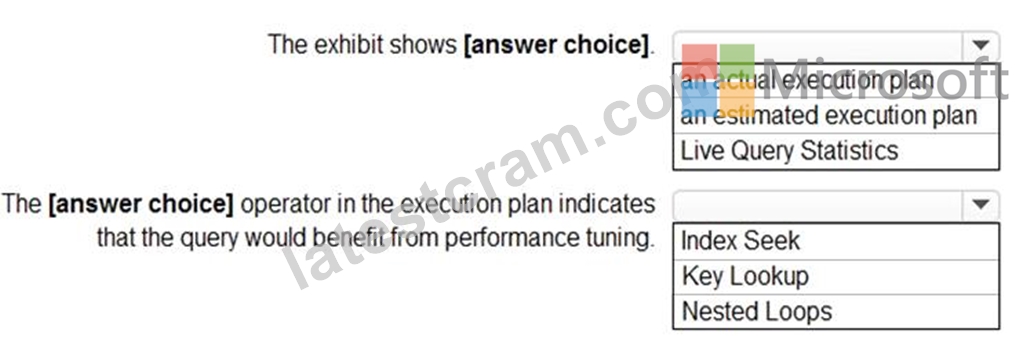
Answer:
Explanation:
Reference:
https://docs.microsoft.com/en-us/sql/relational-databases/performance/live-query-statistics?view=sql-server-ver15
NEW QUESTION 21
You have an Azure SQL database named db1 on a server named server1.
You need to modify the MAXDOP settings for db1.
What should you do?
- A. Connect to db1 and run the sp_configure command.
- B. Connect to the master database of server1 and run the sp_configure command.
- C. Modify the database scoped configuration of db1.
- D. Configure the extended properties of db1.
Answer: C
Explanation:
Reference:
https://docs.microsoft.com/en-us/azure/azure-sql/database/configure-max-degree-of-parallelism
NEW QUESTION 22
You have an Azure SQL Database managed instance named SQLMI1. A Microsoft SQL Server Agent job runs on SQLMI1.
You need to ensure that an automatic email notification is sent once the job completes.
What should you include in the solution?
- A. From the Azure portal, create an Azure Monitor action group that has an Email/SMS/Push/Voice action
- B. From SQL Server Configuration Manager (SSMS), enable SQL Server Agent
- C. From SQL Server Management Studio (SSMS), run sp_set_sqlagent_properties
- D. From SQL Server Management Studio (SSMS), create a Database Mail profile
Answer: D
Explanation:
To send a notification in response to an alert, you must first configure SQL Server Agent to send mail.
Using SQL Server Management Studio; to configure SQL Server Agent to use Database Mail:
1. In Object Explorer, expand a SQL Server instance.
2. Right-click SQL Server Agent, and then click Properties.
3. Click Alert System.
4. Select Enable Mail Profile.
5. In the Mail system list, select Database Mail.
6. In the Mail profile list, select a mail profile for Database Mail.
7. Restart SQL Server Agent.
Note: Prerequisites include:
* Enable Database Mail.
* Create a Database Mail account for the SQL Server Agent service account to use.
* Create a Database Mail profile for the SQL Server Agent service account to use and add the user to the DatabaseMailUserRole in the msdb database.
* Set the profile as the default profile for the msdb database.
Reference:
https://docs.microsoft.com/en-us/sql/relational-databases/database-mail/configure-sql-server-agent-mail-to- use-database-mail Plan and Implement a High Availability and Disaster Recovery (HADR) Environment Testlet 1 This is a case study. Case studies are not timed separately. You can use as much exam time as you would like to complete each case. However, there may be additional case studies and sections on this exam. You must manage your time to ensure that you are able to complete all questions included on this exam in the time provided.
To answer the questions included in a case study, you will need to reference information that is provided in the case study. Case studies might contain exhibits and other resources that provide more information about the scenario that is described in the case study. Each question is independent of the other questions in this case study.
At the end of this case study, a review screen will appear. This screen allows you to review your answers and to make changes before you move to the next section of the exam. After you begin a new section, you cannot return to this section.
To start the case study
To display the first question in this case study, click the Next button. Use the buttons in the left pane to explore the content of the case study before you answer the questions. Clicking these buttons displays information such as business requirements, existing environment, and problem statements. If the case study has an All Information tab, note that the information displayed is identical to the information displayed on the subsequent tabs. When you are ready to answer a question, click the Question button to return to the question.
Existing Environment
Network Environment
The manufacturing and research datacenters connect to the primary datacenter by using a VPN.
The primary datacenter has an ExpressRoute connection that uses both Microsoft peering and private peering.
The private peering connects to an Azure virtual network named HubVNet.
Identity Environment
Litware has a hybrid Azure Active Directory (Azure AD) deployment that uses a domain named litwareinc.com.
All Azure subscriptions are associated to the litwareinc.com Azure AD tenant.
Database Environment
The sales department has the following database workload:
* An on-premises named SERVER1 hosts an instance of Microsoft SQL Server 2012 and two 1-TB databases.
* A logical server named SalesSrv01A contains a geo-replicated Azure SQL database named SalesSQLDb1.
SalesSQLDb1 is in an elastic pool named SalesSQLDb1Pool. SalesSQLDb1 uses database firewall rules and contained database users.
* An application named SalesSQLDb1App1 uses SalesSQLDb1.
The manufacturing office contains two on-premises SQL Server 2016 servers named SERVER2 and SERVER3. The servers are nodes in the same Always On availability group. The availability group contains a database named ManufacturingSQLDb1 Database administrators have two Azure virtual machines in HubVnet named VM1 and VM2 that run Windows Server 2019 and are used to manage all the Azure databases.
Licensing Agreement
Litware is a Microsoft Volume Licensing customer that has License Mobility through Software Assurance.
Current Problems
SalesSQLDb1 experiences performance issues that are likely due to out-of-date statistics and frequent blocking queries.
Requirements
Planned Changes
Litware plans to implement the following changes:
* Implement 30 new databases in Azure, which will be used by time-sensitive manufacturing apps that have varying usage patterns. Each database will be approximately 20 GB.
* Create a new Azure SQL database named ResearchDB1 on a logical server named ResearchSrv01.
ResearchDB1 will contain Personally Identifiable Information (PII) data.
* Develop an app named ResearchApp1 that will be used by the research department to populate and access ResearchDB1.
* Migrate ManufacturingSQLDb1 to the Azure virtual machine platform.
* Migrate the SERVER1 databases to the Azure SQL Database platform.
Technical Requirements
Litware identifies the following technical requirements:
* Maintenance tasks must be automated.
* The 30 new databases must scale automatically.
* The use of an on-premises infrastructure must be minimized.
* Azure Hybrid Use Benefits must be leveraged for Azure SQL Database deployments.
* All SQL Server and Azure SQL Database metrics related to CPU and storage usage and limits must be analyzed by using Azure built-in functionality.
Security and Compliance Requirements
Litware identifies the following security and compliance requirements:
* Store encryption keys in Azure Key Vault.
* Retain backups of the PII data for two months.
* Encrypt the PII data at rest, in transit, and in use.
* Use the principle of least privilege whenever possible.
* Authenticate database users by using Active Directory credentials.
* Protect Azure SQL Database instances by using database-level firewall rules.
* Ensure that all databases hosted in Azure are accessible from VM1 and VM2 without relying on public endpoints.
Business Requirements
Litware identifies the following business requirements:
* Meet an SLA of 99.99% availability for all Azure deployments.
* Minimize downtime during the migration of the SERVER1 databases.
* Use the Azure Hybrid Use Benefits when migrating workloads to Azure.
* Once all requirements are met, minimize costs whenever possible.
NEW QUESTION 23
You are designing a date dimension table in an Azure Synapse Analytics dedicated SQL pool. The date dimension table will be used by all the fact tables.
Which distribution type should you recommend to minimize data movement?
- A. REPLICATE
- B. ROUND_ROBIN
- C. HASH
Answer: A
Explanation:
Section: [none]
Explanation:
A replicated table has a full copy of the table available on every Compute node. Queries run fast on replicated tables since joins on replicated tables don't require data movement. Replication requires extra storage, though, and isn't practical for large tables.
Incorrect Answers:
C: A round-robin distributed table distributes table rows evenly across all distributions. The assignment of rows to distributions is random. Unlike hash-distributed tables, rows with equal values are not guaranteed to be assigned to the same distribution.
As a result, the system sometimes needs to invoke a data movement operation to better organize your data before it can resolve a query.
Reference:
https://docs.microsoft.com/en-us/azure/synapse-analytics/sql-data-warehouse/sql-data-warehouse-tables- distribute
NEW QUESTION 24
You are monitoring an Azure Stream Analytics job.
You discover that the Backlogged input Events metric is increasing slowly and is consistently non-zero.
You need to ensure that the job can handle all the events.
What should you do?
- A. Remove any named consumer groups from the connection and use $default.
- B. Change the compatibility level of the Stream Analytics job.
- C. Create an additional output stream for the existing input stream.
- D. Increase the number of streaming units (SUs).
Answer: D
Explanation:
Backlogged Input Events: Number of input events that are backlogged. A non-zero value for this metric implies that your job isn't able to keep up with the number of incoming events. If this value is slowly increasing or consistently non-zero, you should scale out your job, by increasing the SUs.
Reference:
https://docs.microsoft.com/en-us/azure/stream-analytics/stream-analytics-monitoring
NEW QUESTION 25
You need to configure user authentication for the SERVER1 databases. The solution must meet the security and compliance requirements.
Which three actions should you perform in sequence? To answer, move the appropriate actions from the list of actions to the answer area and arrange them in the correct order.
Answer:
Explanation:
Explanation:
Scenario: Authenticate database users by using Active Directory credentials.
The configuration steps include the following procedures to configure and use Azure Active Directory authentication.
* Create and populate Azure AD.
* Optional: Associate or change the active directory that is currently associated with your Azure Subscription.
* Create an Azure Active Directory administrator. (Step 1)
* Configure your client computers.
* Create contained database users in your database mapped to Azure AD identities. (Step 2)
* Connect to your database by using Azure AD identities. (Step 3)
Reference:
https://docs.microsoft.com/en-us/azure/azure-sql/database/authentication-aad-overview
NEW QUESTION 26
You need to configure user authentication for the SERVER1 databases. The solution must meet the security and compliance requirements.
Which three actions should you perform in sequence? To answer, move the appropriate actions from the list of actions to the answer area and arrange them in the correct order.
Answer:
Explanation:
1 - Create an Azure Active Directory administrator for the logical server
2 - Create contained database users
3 - Connect to your database by using Azure AD account
Reference:
https://docs.microsoft.com/en-us/azure/azure-sql/database/authentication-aad-overview
NEW QUESTION 27
HOTSPOT
You plan to develop a dataset named Purchases by using Azure Databricks. Purchases will contain the following columns:
* ProductID
* ItemPrice
* LineTotal
* Quantity
* StoreID
* Minute
* Month
* Hour
* Year
* Day
You need to store the data to support hourly incremental load pipelines that will vary for each StoreID. The solution must minimize storage costs.
How should you complete the code? To answer, select the appropriate options in the answer area.
NOTE: Each correct selection is worth one point.
Hot Area:
Answer:
Explanation:
Section: [none]
Explanation:
Box 1: .partitionBy
Example:
df.write.partitionBy("y","m","d")
.mode(SaveMode.Append)
.parquet("/data/hive/warehouse/db_name.db/" + tableName)
Box 2: ("Year","Month","Day","Hour","StoreID")
Box 3: .parquet("/Purchases")
Reference:
https://intellipaat.com/community/11744/how-to-partition-and-write-dataframe-in-spark-without-deleting- partitions-with-no-new-data
NEW QUESTION 28
You have an Azure SQL database named DB3.
You need to provide a user named DevUser with the ability to view the properties of DB3 from Microsoft SQL
Server Management Studio (SSMS) as shown in the exhibit. (Click the Exhibit tab.)
Which Transact-SQL command should you run?
- A. GRANT SHOWPLAN TO DevUser
- B. GRANT VIEW DATABASE STATE TO DevUser
- C. GRANT SELECT TO DevUser
- D. GRANT VIEW DEFINITION TO DevUser
Answer: B
Explanation:
Section: [none]
Explanation:
The exhibits displays Database [State] properties.
To query a dynamic management view or function requires SELECT permission on object and VIEW SERVER
STATE or VIEW DATABASE STATE permission.
Reference:
https://docs.microsoft.com/en-us/sql/relational-databases/databases/database-properties-options-page
NEW QUESTION 29
Note: This question is part of a series of questions that present the same scenario. Each question in the series contains a unique solution that might meet the stated goals. Some question sets might have more than one correct solution, while others might not have a correct solution.
After you answer a question in this section, you will NOT be able to return to it. As a result, these questions will not appear in the review screen.
You have two Azure SQL Database servers named Server1 and Server2. Each server contains an Azure SQL database named Database1.
You need to restore Database1 from Server1 to Server2. The solution must replace the existing Database1 on Server2.
Solution: From the Azure portal, you delete Database1 from Server2, and then you create a new database on Server2 by using the backup of Database1 from Server1.
Does this meet the goal?
- A. No
- B. Yes
Answer: A
Explanation:
Section: [none]
Explanation:
Instead restore Database1 from Server1 to the Server2 by using the RESTORE Transact-SQL command and the REPLACE option.
Note: REPLACE should be used rarely and only after careful consideration. Restore normally prevents accidentally overwriting a database with a different database. If the database specified in a RESTORE statement already exists on the current server and the specified database family GUID differs from the database family GUID recorded in the backup set, the database is not restored. This is an important safeguard.
Reference:
https://docs.microsoft.com/en-us/sql/t-sql/statements/restore-statements-transact-sql
NEW QUESTION 30
You are planning the migration of the SERVER1 databases. The solution must meet the business requirements.
What should you include in the migration plan? To answer, select the appropriate options in the answer area.
NOTE: Each correct selection is worth one point.
Answer:
Explanation:
Explanation:
Azure Database Migration service
Box 1: Premium 4-VCore
Scenario: Migrate the SERVER1 databases to the Azure SQL Database platform.
* Minimize downtime during the migration of the SERVER1 databases.
Premimum 4-vCore is for large or business critical workloads. It supports online migrations, offline migrations, and faster migration speeds.
Incorrect Answers:
The Standard pricing tier suits most small- to medium- business workloads, but it supports offline migration only.
Box 2: A VPN gateway
You need to create a Microsoft Azure Virtual Network for the Azure Database Migration Service by using the Azure Resource Manager deployment model, which provides site-to-site connectivity to your on-premises source servers by using either ExpressRoute or VPN.
Reference:
https://azure.microsoft.com/pricing/details/database-migration/
https://docs.microsoft.com/en-us/azure/dms/tutorial-sql-server-azure-sql-online
NEW QUESTION 31
HOTSPOT
You need to implement the monitoring of SalesSQLDb1. The solution must meet the technical requirements.
How should you collect and stream metrics? To answer, select the appropriate options in the answer area.
NOTE: Each correct selection is worth one point.
Hot Area:
Answer:
Explanation:
Explanation:
Box 1: The server, the elastic pool, and the database
Senario:
SalesSQLDb1 is in an elastic pool named SalesSQLDb1Pool.
Litware technical requirements include: all SQL Server and Azure SQL Database metrics related to CPU and storage usage and limits must be analyzed by using Azure built-in functionality.
Box 2: Azure Event hubs
Scenario: Migrate ManufacturingSQLDb1 to the Azure virtual machine platform.
Event hubs are able to handle custom metrics.
Incorrect Answers:
Azure Log Analytics
Azure metric and log data are sent to Azure Monitor Logs, previously known as Azure Log Analytics, directly by Azure. Azure SQL Analytics is a cloud only monitoring solution supporting streaming of diagnostics telemetry for all of your Azure SQL databases.
However, because Azure SQL Analytics does not use agents to connect to Azure Monitor, it does not support monitoring of SQL Server hosted on-premises or in virtual machines.
Monitor and Optimize Operational Resources
Question Set 2
NEW QUESTION 32
You have SQL Server on an Azure virtual machine.
You need to use Policy-Based Management in Microsoft SQL Server to identify stored procedures that do not comply with your naming conventions.
Which three actions should you perform in sequence? To answer, move the appropriate actions from the list of actions to the answer area and arrange them in the correct order.
Answer:
Explanation:
1 - Create a custom condition based on a built-in facet.
2 - Create a custom policy based on a condition.
3 - Run a policy evaluation.
Reference:
https://www.mssqltips.com/sqlservertip/2298/enforce-sql-server-database-naming-conventions-using-policy-based-management/
NEW QUESTION 33
You need to implement the monitoring of SalesSQLDb1. The solution must meet the technical requirements.
How should you collect and stream metrics? To answer, select the appropriate options in the answer area.
NOTE: Each correct selection is worth one point.
Answer:
Explanation:
NEW QUESTION 34
......
DP-300 Dumps - Pass Your Certification Exam: https://www.latestcram.com/DP-300-exam-cram-questions.html
Latest Real Microsoft DP-300 Exam Dumps Questions: https://drive.google.com/open?id=1CMDjlsS3p0RS4T_gMzUmgmEJcSvnADM9
