

[Mar-2026] HCVA0-003 Questions - Truly Beneficial For Your HashiCorp Exam
Download HashiCorp HCVA0-003 Sample Questions
NEW QUESTION # 13
Given the following screenshot, how many secrets engines have been enabled by a Vault user?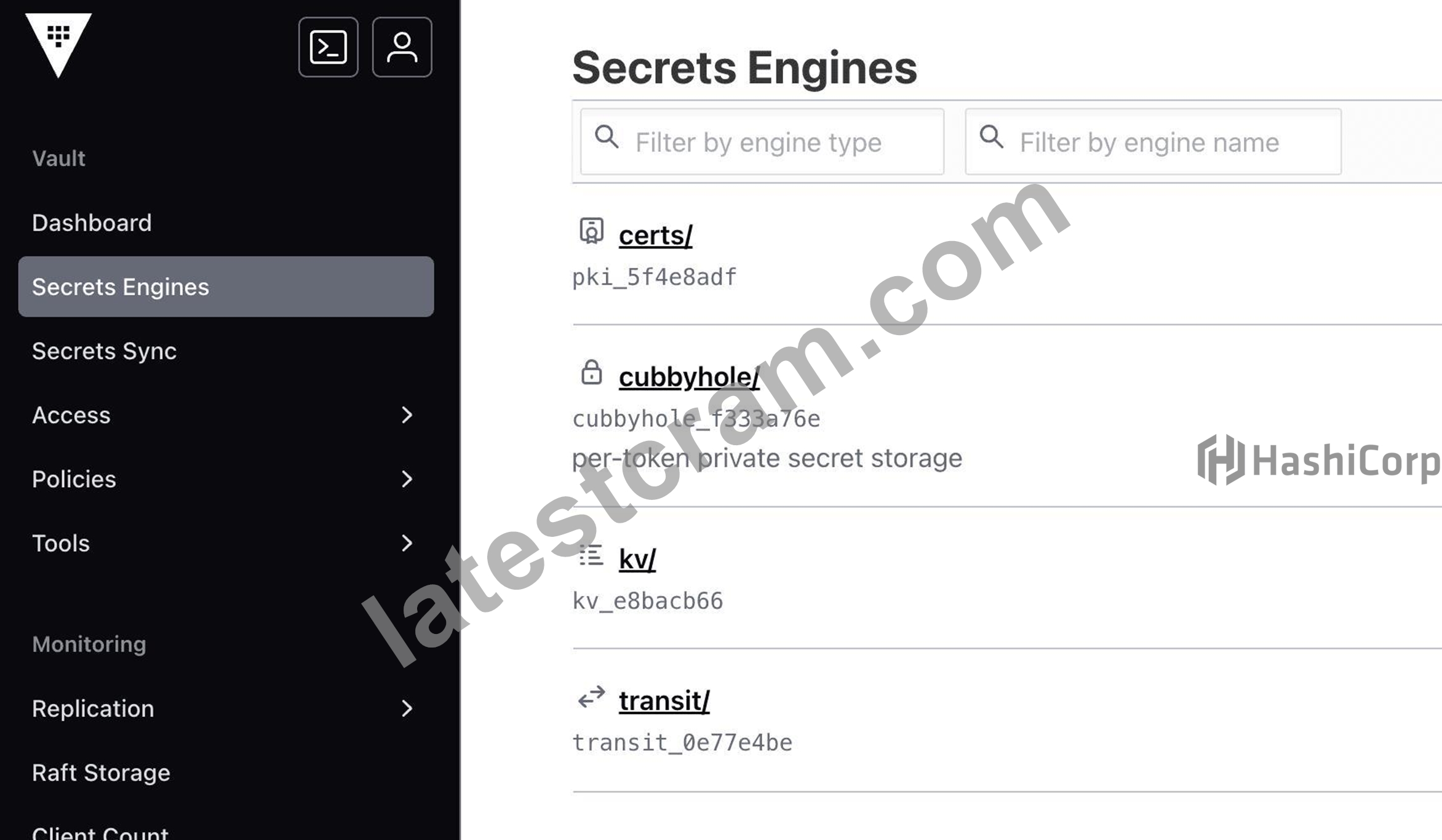
- A. 0
- B. 1
- C. 2
- D. 3
Answer: C
Explanation:
Comprehensive and Detailed in Depth Explanation:
* cubbyhole is default; kv and transit are user-enabled. Total: 3.
Overall Explanation from Vault Docs:
"cubbyhole is enabled by default... User-enabled engines add to this."
Reference:https://developer.hashicorp.com/vault/docs/secrets/cubbyhole
NEW QUESTION # 14
What type of Vault token does not have a TTL (Time to Live)?
- A. Batch tokens
- B. Service tokens
- C. Child tokens
- D. Root tokens
- E. Parent tokens
Answer: D
Explanation:
Comprehensive and Detailed in Depth Explanation:
Root tokens in Vault are unique in lacking a TTL. The HashiCorp Vault documentation states: "Non-root tokens are associated with a TTL, which determines for how long a token is valid. Root tokens are not associated with a TTL, and therefore, do not expire." It provides an example: "For example, notice that the value for token_duration is the infinity symbol, meaning it lives forever," as seen in a vault login output for a root token.
The docs elaborate: "Root tokens are tokens with an infinite TTL that have the 'root' policy attached to them.
Because of their power, it is strongly recommended that they be used only as necessary and then immediately revoked when no longer needed." In contrast:
* Child tokens (A)inherit TTLs from parents.
* Parent tokens (B)typically have TTLs unless they are root.
* Service tokens (C)have configurable TTLs for ongoing use.
* Batch tokens (E)have fixed TTLs for ephemeral tasks.Thus, D (Root tokens) is correct.
Reference:
HashiCorp Vault Documentation - Tokens: Token Time to Live
NEW QUESTION # 15
Vault is configured with the oidc auth method and you need to log in using the CLI. What command would you use to authenticate so you can make configuration changes to Vault?
- A. vault login username=bryan
- B. vault login -method=oidc username=bryan
- C. vault login auth/oidc/users/bryan
- D. vault auth oidc
Answer: B
Explanation:
Comprehensive and Detailed In-Depth Explanation:
To authenticate via the OIDC auth method using the CLI, the vault login command with the -method flag is used. The Vault documentation states:
"To authenticate using the CLI, you could use the command vault login and specify the auth methodyou wish to use by using the -method flag. For example, if you wanted to authenticate using OIDC, you could use vault login -method=oidc [options]."
-Vault Commands: login
* A: vault login -method=oidc username=bryan is correct, specifying the OIDC method and username:
"The correct command to authenticate using the oidc auth method in Vault is vault login -method=oidc username=bryan."
-Vault Auth: OIDC
* B: vault auth oidc is invalid; auth is not a login command.
* C: vault login auth/oidc/users/bryan is incorrect syntax; it mimics an API path, not a CLI command.
* D: vault login username=bryan lacks the method specification, defaulting to token auth.
References:
Vault Commands: login
Vault Auth: OIDC
NEW QUESTION # 16
You are planning the deployment of your first Vault cluster and have decided to use Integrated Storage as the storage backend. Where do you configure the storage backend to be used by Vault?
- A. In the systemd service file
- B. In the Vault configuration file
- C. In the Vault Agent sink file
- D. Inside the Vault service once Vault is up and running
Answer: B
Explanation:
Comprehensive and Detailed In-Depth Explanation:
The storage backend is configured in the Vault configuration file. The Vault documentation states:
"The Vault configuration file includes different stanzas and parameters to define a variety of configuration options. These configurations include the storage backend, listener, TLS certificates, seal type, cluster name, log level, UI, cluster IP address, and a few more. Most of these are required to get Vault up and running in the first place, so they must be placed in the configuration file."
-Vault Configuration
* C: Correct. For Integrated Storage:
"Configuring the storage backend to be used by Vault is done in the Vault configuration file."
-Vault Configuration: Raft Storage
* A: systemd manages the service, not storage.
* B: Backend must be set before running.
* D: Agent sink is for client tokens.
References:
Vault Configuration
Vault Configuration: Raft Storage
NEW QUESTION # 17
You need to decrypt customer data to provide it to an application. When you run the decryption command, you get the output below. Why does the response not directly reveal the cleartext data?
$ vault write transit/decrypt/phone_number ciphertext="vault:v1:tgx2vsxtlQRfyLSKvem..." Key Value
--- -----
plaintext aGFzaGljb3JwIGNlcnRpZmllZDogdmF1bHQgYXNzb2NpYXRl
- A. The user does not have permission to view the cleartext data
- B. The output is base64 encoded
- C. The original data must have been encrypted
- D. The output is actually a response wrapped token that needs to be unwrapped
Answer: B
Explanation:
Comprehensive and Detailed In-Depth Explanation:
The Vault Transit secrets engine returns decrypted data inbase64-encoded format:
* B. The output is base64 encoded: "All plaintext data must be base64-encoded before being encrypted by Vault. As a result, decrypted data is always base64 encoded." Users must decode it (e.g., using base64 -d) to see cleartext.
* Incorrect Options:
* A. Permission Issue: Permissions would cause an error, not encoded output. "Not because the user lacks permission."
* C. Wrapped Token: The output is plaintext, not a token. "Not a response wrapped token."
* D. Original Encryption: Irrelevant; the issue is encoding, not encryption state.
This encoding ensures safe transmission of binary data.
Reference:https://developer.hashicorp.com/vault/docs/secrets/transit#usage
NEW QUESTION # 18
After a client has authenticated to Vault, what security feature is used to make all subsequent calls?
- A. key shard
- B. token
- C. ldap
- D. pgp
- E. listener
- F. path
Answer: B
Explanation:
Comprehensive and Detailed in Depth Explanation:
After authentication, Vault usestokensfor all subsequent calls. The HashiCorp Vault documentation states:
"After authenticating, a client is issued a service token which is associated with a policy. That token is used to make all subsequent requests to Vault." Tokens serve as the primary security feature for authorizing and authenticating requests.
The docs elaborate: "Tokens are the core method for authentication within Vault. Once authenticated, the client uses this token to access secrets and perform operations according to the attached policies." Other options likeldap,pgp,path,key shard, andlistenerare unrelated to this role. Thus, F is correct.
Reference:
HashiCorp Vault Documentation - Authentication Concepts
NEW QUESTION # 19
What are the primary benefits of running Vault in a production deployment over dev server mode (select two)?
- A. Faster deployment
- B. Ability to enable auth methods
- C. Encryption via TLS
- D. Persistent storage
Answer: C,D
Explanation:
Comprehensive and Detailed in Depth Explanation:
* A:Dev mode is faster to deploy; incorrect.
* B:Production uses persistent storage vs. dev's in-memory. Correct.
* C:Auth methods work in both modes. Incorrect.
* D:Production enables TLS; dev uses plaintext. Correct.
Overall Explanation from Vault Docs:
"Dev server mode stores data in memory... Production mode supports persistent storage and TLS encryption." Reference:https://developer.hashicorp.com/vault/docs/concepts/dev-server
NEW QUESTION # 20
Which of the following is true about the token authentication method in Vault? (Select three)
- A. The token auth method is automatically enabled in Vault and cannot be disabled
- B. Tokens cannot be used directly; they must be used in conjunction with one of Vault's many auth methods
- C. External authentication mechanisms, such as GitHub, are used to dynamically create tokens
- D. The token auth method is used as the first method of authentication for Vault for a newly initialized Vault node/cluster
Answer: A,C,D
Explanation:
Comprehensive and Detailed In-Depth Explanation:
The token auth method is foundational to Vault. The Vault documentation states:
"Tokens are the core method for authentication within Vault. It is also the only auth method that cannot be disabled. If you've gone through the getting started guide, you probably noticed that vault server -dev (or vault operator init for a non-dev server) outputs an initial 'root token.' This is the first method of authentication for Vault. All external authentication mechanisms, such as GitHub, mapdown to dynamically created tokens."
-Vault Concepts: Tokens
* A,B,C: Correct per the above.
* D: Incorrect; tokens can be used directly:
"Tokens can be used directly or auth methods can be used to dynamically generate tokens based on external identities."
-Vault Concepts: Tokens
References:
Vault Concepts: Tokens
NEW QUESTION # 21
Tommy has written an AWS Lambda function that will perform certain tasks for the organization when data has been uploaded to an S3 bucket. Security policies for the organization do not allow Tommy to hardcode any type of credential within the Lambda code or environment variables. However, Tommy needs to retrieve a credential from Vault to write data to an on-premises database. What auth method should Tommy use in Vault to meet the requirements while not violating security policies?
- A. Userpass
- B. Token
- C. AWS
- D. AppRole
Answer: C
Explanation:
Comprehensive and Detailed in Depth Explanation:
* A:AWS auth uses IAM roles, avoiding hardcoded credentials. Correct for Lambda.
* B:Userpass requires username/password, violating policy. Incorrect.
* C:Token requires a pre-generated token, often hardcoded. Incorrect.
* D:AppRole needs RoleID/SecretID, typically hardcoded. Incorrect.
Overall Explanation from Vault Docs:
"The AWS auth method provides an automated mechanism to retrieve a Vault token for IAM principals... no manual credential provisioning required." Reference:https://developer.hashicorp.com/vault/docs/auth/aws#aws-auth-method
NEW QUESTION # 22
Your organization audited an essential application and found it isn't securely storing data. For added security, auditors recommended encrypting all data before storing it in a backend database, and the application server should not store encryption keys locally. Which secrets engine meets these requirements?
- A. PKI secrets engine
- B. SSH secrets engine
- C. Transit secrets engine
- D. Cubbyhole secrets engine
Answer: C
Explanation:
Comprehensive and Detailed In-Depth Explanation:
The Transit secrets engine encrypts data without local key storage. The Vault documentation states:
"The Transit secrets engine allows you to send cleartext data to Vault to be encrypted. Vault will encrypt the data with the referenced encryption key, which is stored locally, and returns the ciphertext to the application.
Although the encryption keys in the Transit secrets engine are exportable, they are generally kept in Vault."
-Transit Tutorial
* C: Correct. Meets encryption and key security needs:
"It allows applications to encrypt data before storing it in a backend database and decrypt it when needed, without storing encryption keys locally."
-Vault Secrets: Transit
* A: PKI is for certificates.
* B: SSH is for SSH credentials.
* D: Cubbyhole is for temporary storage.
References:
Transit Tutorial
Vault Secrets: Transit
NEW QUESTION # 23
True or False? The following policy permits a user to read secrets contained in the path secrets/cloud/apps
/jenkins?
text
CollapseWrapCopy
path "secrets/cloud/apps/jenkins/*" {
capabilities = ["create", "read", "update", "delete", "list"]
}
- A. False
- B. True
Answer: A
Explanation:
Comprehensive and Detailed In-Depth Explanation:
The policy's path syntax determines access:
* B. False: "This policy will NOT permit access to secrets stored under secrets/cloud/apps/jenkins." The wildcard * applies to pathsafterjenkins/, e.g., secrets/cloud/apps/jenkins/config, but not the exact path secrets/cloud/apps/jenkins. "Notice that in the policy, the wildcard (*) is AFTER the path jenkins, and not AT the jenkins path."
* Incorrect Option:
* A. True: Incorrect; the policy requires an additional segment to match.
To permit secrets/cloud/apps/jenkins, the policy should be path "secrets/cloud/apps/jenkins" {} or include a broader wildcard like secrets/cloud/apps/*.
Reference:https://developer.hashicorp.com/vault/docs/concepts/policies
NEW QUESTION # 24
You have multiple Vault clusters in your environment, one for test and one for production. You have the CLI installed on your local machine and need to target the production cluster to make configuration changes. What environment variable can you set to target the production cluster?
- A. VAULT_CLUSTER_ADDR
- B. VAULT_REDIRECT_ADDR
- C. VAULT_ADDR
- D. VAULT_CAPATH
Answer: C
Explanation:
Comprehensive and Detailed In-Depth Explanation:
The VAULT_ADDR variable specifies the target Vault server. The Vault documentation states:
"VAULT_ADDR is the environment variable that is used to specify the address of the Vault server expressed as a URL and port, for example: https://vault.bryankrausen.com:8200/. You can easily modify the value of the environment variable whenever you want to target a different Vault node/cluster."
-Vault Environment Variables
* C: Correct. Sets the production cluster address:
"Setting the VAULT_ADDR environment variable allows you to specify the address of the Vault server you want to target."
-Vault Environment Variables
* A,B,D: Incorrect; unrelated to CLI targeting.
References:
Vault Environment Variables
NEW QUESTION # 25
The key/value v2 secrets engine is enabled at secret/ See the following policy: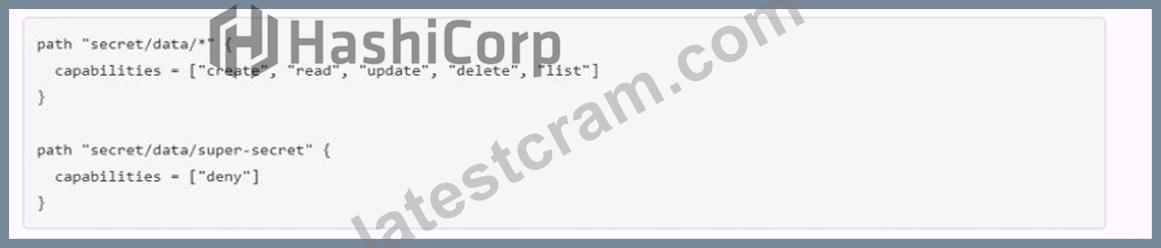
Which of the following operations are permitted by this policy? Choose two correct answers.
- A. vault kv list secret/super-secret
- B. vault kv metadata get secret/webapp1
- C. vault kv put secret/webapp1 apikey-"ABCDEFGHI] K123M"
- D. vault kv delete secret/super-secret
- E. vault kv get secret/webapp1
Answer: B,E
Explanation:
The policy shown in the image is:
path "secret/data/webapp1" { capabilities = ["create", "read", "update", "delete", "list"] } path "secret/data/super-secret" { capabilities = ["deny"] } This policy grants or denies access to the key/value v2 secrets engine mounted at secret/ according to the following rules:
* The path "secret/data/webapp1" has the capabilities of "create", "read", "update", "delete", and "list".
This means that the policy allows performing any of these operations on the secrets stored under this path. The data/ prefix is used to access the actual secret data in the key/value v2 secrets engine5. Therefore, the policy permits the operation of vault kv get secret/webapp1, which reads the secret data at secret/data/webapp16.
* The path "secret/data/super-secret" has the capability of "deny". This means that the policy denies performing any operation on the secrets stored under this path. The policy overrides any other policy that might grant access to this path. Therefore, the policy does not permit the operations of vault kv delete secret/super-secret and vault kv list secret/super-secret, which delete and list the secret data at secret/data/super-secret respectively6.
* The policy does not explicitly define any rules for the path "secret/metadata". The metadata/ prefix is used to access the metadata of the secrets in the key/value v2 secrets engine, such as the number of versions, the deletion status, the creation time, etc5. By default, if the policy grants any of the capabilities of "create", "read", "update", or "delete" on the data/ path, it also grants the same capabilities on the corresponding metadata/ path7. Therefore, the policy permits the operation of vault kv metadata get secret/webapp1, which reads the metadata of the secret at secret/metadata/webapp18.
5 (https://developer.hashicorp.com/vault/docs/secrets/kv/kv-v2), [6]6, 7 (https://developer.hashicorp.com/vault/docs/secrets/kv/kv-v2), [8]8
NEW QUESTION # 26
When a lease is created, what actions can be performed by using only the lease ID? (Choose two)
- A. Renew the lease
- B. Authenticate using the lease ID
- C. Revoke the lease
- D. Extend the max TTL for the lease
Answer: A,C
Explanation:
Comprehensive and Detailed In-Depth Explanation:
A lease ID in Vault identifies a lease associated with dynamic secrets, allowing specific management actions:
* A. Renew the lease: "Using the lease ID, the lease can be renewed up until the maximum TTL," extending its duration without altering other properties.
* B. Revoke the lease: "It is possible to revoke the lease, which immediately invalidates the lease and any associated resources." This terminates the lease instantly.
* Incorrect Options:
* C. Extend the max TTL: Requires configuration changes beyond the lease ID. "This operation typically involves modifying the configuration."
* D. Authenticate: Lease IDs are for lease management, not authentication. "The lease ID does not have any direct relationship to authentication processes." Lease IDs enable precise control over dynamic secret lifecycles.
Reference:https://developer.hashicorp.com/vault/docs/commands/lease
NEW QUESTION # 27
You have a new team member on the Vault operations team. Their first task is to rotate the encryption key in Vault as part of the organization's security policy. However, when they log in, they get an access denied error when attempting to rotate the key. The policy being used is below. Why can't the user rotate the encryption key?
path "auth/*" {
capabilities = ["create", "read", "update", "delete", "list"]
}
path "sys/rotate" {
capabilities = ["read", "update"]
}
- A. The policy doesn't include create privileges so a new encryption key can't be created
- B. The policy should include sys/rotate/<name of key> as part of the path
- C. The policy requires sudo privileges since it is a root-protected path
- D. The encryption key has a minimum TTL, therefore the key cannot be rotated until that time expires
Answer: C
Explanation:
Comprehensive and Detailed In-Depth Explanation:
Rotating the encryption key in Vault is done via the sys/rotate endpoint, a root-protected path requiring sudo capability in addition to update. The provided policy grants read and update on sys/rotate, but lacks sudo, resulting in an access denied error. Option B (create) isn't required for rotation, per the API docs. Option C is incorrect; sys/rotate is the fixed endpoint, not key-specific. Option D (TTL) isn't a Vault restriction for key rotation. The policies tutorial confirms sudo is needed for root-protected paths like this.
References:
Root-Protected Endpoints
Sys/Rotate API
NEW QUESTION # 28
Your company's security policies require that all encryption keys must be rotated at least once per year. After using the Transit secrets engine for a year, the Vault admin issues the proper command to rotate the key named ecommerce that was used to encrypt your data. What command can be used to easily re-encrypt the original data with the new version of the key?
- A. vault write -f transit/keys/ecommerce/update <old data>
- B. vault write transit/rewrap/ecommerce ciphertext=<old data>
- C. vault write transit/encrypt/ecommerce v1:v2 <old data>
- D. vault write -f transit/keys/ecommerce/rotate <old data>
Answer: B
Explanation:
Comprehensive and Detailed in Depth Explanation:
The Transit secrets engine in Vault manages encryption keys and supports key rotation. After rotating the ecommerce key, existing ciphertext (encrypted with the old key version) must be re-encrypted (rewrapped) with the new key version without exposing plaintext. Let's evaluate:
* A: vault write -f transit/keys/ecommerce/rotate <old data>This command rotates the key, creating a new version, but does not re-encrypt existing data. It's for key management, not data rewrapping.
Incorrect.
* B: vault write -f transit/keys/ecommerce/update <old data>There's no update endpoint in Transit for re-encrypting data. This is invalid and incorrect.
* C: vault write transit/encrypt/ecommerce v1:v2 <old data>The transit/encrypt endpoint encrypts new plaintext, not existing ciphertext. The v1:v2 syntax is invalid. Incorrect.
* D: vault write transit/rewrap/ecommerce ciphertext=<old data>The transit/rewrap endpoint takes existing ciphertext, decrypts it with the old key version, and re-encrypts it with the latest key version (post-rotation). This is the correct command. For example, if <old data> is vault:v1:cZNHVx+..., the output might be vault:v2:kChHZ9w4....
Overall Explanation from Vault Docs:
"Vault's Transit secrets engine supports key rotation... The rewrap endpoint allows ciphertext encrypted with an older key version to be re-encrypted with the latest key version without exposing the plaintext." This operation is secure and efficient, using the keyring internally.
Reference:https://developer.hashicorp.com/vault/tutorials/encryption-as-a-service/eaas-transit-rewrap
NEW QUESTION # 29
When using Integrated Storage, which of the following should you do to recover from possible data loss?
- A. Use audit logs
- B. Use snapshot
- C. Use server logs
- D. Failover to a standby node
Answer: B
Explanation:
Integrated Storage is a Raft-based storage backend that allows Vault to store its data internally without relying on an external storage system. It also enables Vault to run in high availability mode with automatic leader election and failover. However, Integrated Storage is not immune to data loss or corruption due to hardware failures, network partitions, or human errors. Therefore, it is recommended to use the snapshot feature to backup and restore the Vault data periodically or on demand. A snapshot is a point-in-time capture of the entire Vault data, including the encrypted secrets, the configuration, and the metadata. Snapshots can be taken and restored using the vault operator raft snapshot command or the sys/storage/raft/snapshot API endpoint.
Snapshots are encrypted and can only be restored with a quorum of unseal keys or recovery keys. Snapshots are also portable and can be used to migrate data between different Vault clusters or storage backends. References: https://developer.hashicorp.com/vault/docs/concepts/integrated-storage1,
https://developer.hashicorp.com/vault/docs/commands/operator/raft/snapshot2, https://developer.hashicorp.
com/vault/api-docs/system/storage/raft/snapshot3
NEW QUESTION # 30
......
HashiCorp HCVA0-003 Exam Syllabus Topics:
| Topic | Details |
|---|---|
| Topic 1 |
|
| Topic 2 |
|
| Topic 3 |
|
| Topic 4 |
|
Truly Beneficial For Your HashiCorp Exam: https://www.latestcram.com/HCVA0-003-exam-cram-questions.html
Real HCVA0-003 Exam Questions and Answers FREE: https://drive.google.com/open?id=1v-EAeiLnrTQ_ZzM6eAZoU0exmnM2GdeE
