

Databricks Certified Databricks-Certified-Data-Engineer-Associate Dumps Questions Valid Databricks-Certified-Data-Engineer-Associate Materials
Current Databricks-Certified-Data-Engineer-Associate Exam Dumps [2025] Complete Databricks Exam Smoothly
The GAQM Databricks-Certified-Data-Engineer-Associate (Databricks Certified Data Engineer Associate) Certification Exam is designed to validate the skills and knowledge of data engineers who work with the Databricks Unified Analytics Platform. Databricks Certified Data Engineer Associate Exam certification is ideal for professionals who want to demonstrate their expertise in building and optimizing data pipelines, data transformation, and data storage using Databricks.
NEW QUESTION # 59
A data engineer has a Job with multiple tasks that runs nightly. Each of the tasks runs slowly because the clusters take a long time to start.
Which of the following actions can the data engineer perform to improve the start up time for the clusters used for the Job?
- A. They can configure the clusters to be single-node
- B. They can use clusters that are from a cluster pool
- C. They can configure the clusters to autoscale for larger data sizes
- D. They can use endpoints available in Databricks SQL
- E. They can use jobs clusters instead of all-purpose clusters
Answer: B
Explanation:
Explanation
Cluster pools are a way to pre-provision clusters that are ready to use. This can reduce the start up time for clusters, as they do not have to be created from scratch. All-purpose clusters are not pre-provisioned, so they will take longer to start up. Jobs clusters are a type of cluster pool, but they are not the best option for this use case. Jobs clusters are designed for long-running jobs, and they can be more expensive than other types of cluster pools. Single-node clusters are the smallest type of cluster, and they will start up the fastest. However, they may not be powerful enough to run the Job's tasks. Autoscaling clusters can scale up or down based on demand. This can help to improve the start up time for clusters, as they will only be created when they are needed. However, autoscaling clusters can also be more expensive than other types of cluster pool
https://docs.databricks.com/en/clusters/pool-best-practices.html
NEW QUESTION # 60
A data engineer needs access to a table new_table, but they do not have the correct permissions. They can ask the table owner for permission, but they do not know who the table owner is.
Which of the following approaches can be used to identify the owner of new_table?
- A. There is no way to identify the owner of the table
- B. Review the Owner field in the table's page in the cloud storage solution
- C. Review the Owner field in the table's page in Data Explorer
- D. Review the Permissions tab in the table's page in Data Explorer
- E. All of these options can be used to identify the owner of the table
Answer: C
NEW QUESTION # 61
Which of the following describes the relationship between Gold tables and Silver tables?
- A. Gold tables are more likely to contain truthful data than Silver tables.
- B. Gold tables are more likely to contain aggregations than Silver tables.
- C. Gold tables are more likely to contain more data than Silver tables.
- D. Gold tables are more likely to contain a less refined view of data than Silver tables.
- E. Gold tables are more likely to contain valuable data than Silver tables.
Answer: D
NEW QUESTION # 62
A data organization leader is upset about the data analysis team's reports being different from the data engineering team's reports. The leader believes the siloed nature of their organization's data engineering and data analysis architectures is to blame.
Which of the following describes how a data lakehouse could alleviate this issue?
- A. Both teams would autoscale their work as data size evolves
- B. Both teams would reorganize to report to the same department
- C. Both teams would respond more quickly to ad-hoc requests
- D. Both teams would be able to collaborate on projects in real-time
- E. Both teams would use the same source of truth for their work
Answer: E
NEW QUESTION # 63
A new data engineering team team has been assigned to an ELT project. The new data engineering team will need full privileges on the table sales to fully manage the project.
Which of the following commands can be used to grant full permissions on the database to the new data engineering team?
- A. GRANT SELECT CREATE MODIFY ON TABLE sales TO team;
- B. GRANT ALL PRIVILEGES ON TABLE sales TO team;
- C. GRANT USAGE ON TABLE sales TO team;
- D. GRANT ALL PRIVILEGES ON TABLE team TO sales;
- E. GRANT SELECT ON TABLE sales TO team;
Answer: B
NEW QUESTION # 64
A data engineer has a Job with multiple tasks that runs nightly. Each of the tasks runs slowly because the clusters take a long time to start.
Which of the following actions can the data engineer perform to improve the start up time for the clusters used for the Job?
- A. They can configure the clusters to be single-node
- B. They can use clusters that are from a cluster pool
- C. They can configure the clusters to autoscale for larger data sizes
- D. They can use endpoints available in Databricks SQL
- E. They can use jobs clusters instead of all-purpose clusters
Answer: B
Explanation:
The best action that the data engineer can perform to improve the start up time for the clusters used for the Job is to use clusters that are from a cluster pool. A cluster pool is a set of idle clusters that can be used by jobs or interactive sessions. By using a cluster pool, the data engineer can avoid the cluster creation time and reduce the latency of the tasks. Cluster pools also offer cost savings and resource efficiency, as they can be shared by multiple users and jobs.
Option A is not relevant, as endpoints available in Databricks SQL are used for creating and managing SQL analytics workloads, not for improving cluster start up time.
Option B is not correct, as jobs clusters and all-purpose clusters have similar start up times. Jobs clusters are clusters that are dedicated to run a single job and are terminated when the job is completed. All-purpose clusters are clusters that can be used for multiple purposes, such as interactive sessions, notebooks, or multiple jobs. Both types of clusters can benefit from using a cluster pool.
Option C is not advisable, as configuring the clusters to be single-node will reduce the parallelism and performance of the tasks. Single-node clusters are clusters that have only one worker node and are typically used for testing or development purposes. They are not suitable for running production jobs that require high scalability and fault tolerance.
Option E is not helpful, as configuring the clusters to autoscale for larger data sizes will not affect the start up time of the clusters. Autoscaling is a feature that allows clusters to dynamically adjust the number of worker nodes based on the workload. It can help optimize the resource utilization and cost efficiency of the clusters, but it does not speed up the cluster creation process.
Reference:
Cluster Pools
Jobs
Clusters
[Databricks Data Engineer Professional Exam Guide]
NEW QUESTION # 65
A data engineer is attempting to drop a Spark SQL table my_table. The data engineer wants to delete all table metadata and data.
They run the following command:
DROP TABLE IF EXISTS my_table
While the object no longer appears when they run SHOW TABLES, the data files still exist.
Which of the following describes why the data files still exist and the metadata files were deleted?
- A. The table did not have a location
- B. The table's data was larger than 10 GB
- C. The table's data was smaller than 10 GB
- D. The table was managed
- E. The table was external
Answer: E
NEW QUESTION # 66
A single Job runs two notebooks as two separate tasks. A data engineer has noticed that one of the notebooks is running slowly in the Job's current run. The data engineer asks a tech lead for help in identifying why this might be the case.
Which of the following approaches can the tech lead use to identify why the notebook is running slowly as part of the Job?
- A. They can navigate to the Runs tab in the Jobs UI to immediately review the processing notebook.
- B. They can navigate to the Tasks tab in the Jobs UI to immediately review the processing notebook.
- C. There is no way to determine why a Job task is running slowly.
- D. They can navigate to the Runs tab in the Jobs UI and click on the active run to review the processing notebook.
- E. They can navigate to the Tasks tab in the Jobs UI and click on the active run to review the processing notebook.
Answer: D
NEW QUESTION # 67
Which of the following describes a benefit of creating an external table from Parquet rather than CSV when using a CREATE TABLE AS SELECT statement?
- A. Parquet files have a well-defined schema
- B. CREATE TABLE AS SELECT statements cannot be used on files
- C. Parquet files can be partitioned
- D. Parquet files will become Delta tables
- E. Parquet files have the ability to be optimized
Answer: A
Explanation:
Explanation
https://www.databricks.com/glossary/what-is-parquet#:~:text=Columnar%20storage%20like%20Apache%20Par Columnar storage like Apache Parquet is designed to bring efficiency compared to row-based files like CSV.
When querying, columnar storage you can skip over the non-relevant data very quickly. As a result, aggregation queries are less time-consuming compared to row-oriented databases.
NEW QUESTION # 68
Which of the following data workloads will utilize a Gold table as its source?
- A. A job that queries aggregated data designed to feed into a dashboard
- B. A job that cleans data by removing malformatted records
- C. A job that enriches data by parsing its timestamps into a human-readable format
- D. A job that aggregates uncleaned data to create standard summary statistics
- E. A job that ingests raw data from a streaming source into the Lakehouse
Answer: A
Explanation:
1: A Gold table is a table that contains highly refined and aggregated data that powers analytics, machine learning, and production applications. It represents data that has been transformed into knowledge, rather than just information. A Gold table is typically the final output of a medallion lakehouse architecture, where data flows from Bronze to Silver to Gold tables, with each layer improving the structure and quality of data. A job that queries aggregated data designed to feed into a dashboard is an example of a data workload that will utilize a Gold table as its source, as it requires data that is ready for consumption and analysis. The other options are either data workloads that will use a Bronze or Silver table as their source, or data workloads that will produce a Gold table as their output. Reference: Databricks Documentation - What is the medallion lakehouse architecture?, Databricks Documentation - What is a Medallion Architecture?, K21Academy - Delta Lake Architecture & Azure Databricks Workspace.
NEW QUESTION # 69
Which of the following describes the relationship between Bronze tables and raw data?
- A. Bronze tables contain raw data with a schema applied.
- B. Bronze tables contain less data than raw data files.
- C. Bronze tables contain a less refined view of data than raw data.
- D. Bronze tables contain more truthful data than raw data.
- E. Bronze tables contain aggregates while raw data is unaggregated.
Answer: E
NEW QUESTION # 70
A data engineer is using the following code block as part of a batch ingestion pipeline to read from a composable table: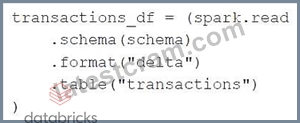
Which of the following changes needs to be made so this code block will work when the transactions table is a stream source?
- A. Replace "transactions" with the path to the location of the Delta table
- B. Replace predict with a stream-friendly prediction function
- C. Replace spark.read with spark.readStream
- D. Replace format("delta") with format("stream")
- E. Replace schema(schema) with option ("maxFilesPerTrigger", 1)
Answer: C
Explanation:
Explanation
https://docs.databricks.com/en/structured-streaming/delta-lake.html
NEW QUESTION # 71
Which of the following benefits of using the Databricks Lakehouse Platform is provided by Delta Lake?
- A. The ability to distribute complex data operations
- B. The ability to collaborate in real time on a single notebook
- C. The ability to set up alerts for query failures
- D. The ability to support batch and streaming workloads
- E. The ability to manipulate the same data using a variety of languages
Answer: D
Explanation:
Explanation
Delta Lake is a key component of the Databricks Lakehouse Platform that provides several benefits, and one of the most significant benefits is its ability to support both batch and streaming workloads seamlessly. Delta Lake allows you to process and analyze data in real-time (streaming) as well as in batch, making it a versatile choice for various data processing needs. While the other options may be benefits or capabilities of Databricks or the Lakehouse Platform in general, they are not specifically associated with Delta Lake.
NEW QUESTION # 72
A new data engineering team has been assigned to work on a project. The team will need access to database customers in order to see what tables already exist. The team has its own group team.
Which of the following commands can be used to grant the necessary permission on the entire database to the new team?
- A. GRANT VIEW ON CATALOG customers TO team;
- B. GRANT CREATE ON DATABASE customers TO team;
- C. GRANT USAGE ON DATABASE customers TO team;
- D. GRANT CREATE ON DATABASE team TO customers;
- E. GRANT USAGE ON CATALOG team TO customers;
Answer: C
Explanation:
The correct command to grant the necessary permission on the entire database to the new team is to use the GRANT USAGE command. The GRANT USAGE command grants the principal the ability to access the securable object, such as a database, schema, or table. In this case, the securable object is the database customers, and the principal is the group team. By granting usage on the database, the team will be able to see what tables already exist in the database. Option E is the only option that uses the correct syntax and the correct privilege type for this scenario. Option A uses the wrong privilege type (VIEW) and the wrong securable object (CATALOG). Option B uses the wrong privilege type (CREATE), which would allow the team to create new tables in the database, but not necessarily see the existing ones. Option C uses the wrong securable object (CATALOG) and the wrong principal (customers). Option D uses the wrong securable object (team) and the wrong principal (customers). Reference: GRANT, Privilege types, Securable objects, Principals
NEW QUESTION # 73
A data engineer needs to create a table in Databricks using data from their organization's existing SQLite database.
They run the following command: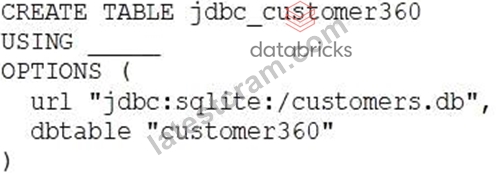
Which of the following lines of code fills in the above blank to successfully complete the task?
- A. org.apache.spark.sql.jdbc
- B. DELTA
- C. autoloader
- D. sqlite
- E. org.apache.spark.sql.sqlite
Answer: D
Explanation:
In the given command, a data engineer is trying to create a table in Databricks using data from an SQLite database. The correct option to fill in the blank is "sqlite" because it specifies the type of database being connected to in a JDBC connection string. The USING clause should be followed by the format of the data, and since we are connecting to an SQLite database, "sqlite" would be appropriate here. References:
* Create a table using JDBC
* JDBC connection string
* SQLite JDBC driver
NEW QUESTION # 74
A data engineer has been using a Databricks SQL dashboard to monitor the cleanliness of the input data to an ELT job. The ELT job has its Databricks SQL query that returns the number of input records containing unexpected NULL values. The data engineer wants their entire team to be notified via a messaging webhook whenever this value reaches 100.
Which of the following approaches can the data engineer use to notify their entire team via a messaging webhook whenever the number of NULL values reaches 100?
- A. They can set up an Alert without notifications.
- B. They can set up an Alert with a new email alert destination.
- C. They can set up an Alert with a new webhook alert destination.
- D. They can set up an Alert with one-time notifications.
- E. They can set up an Alert with a custom template.
Answer: C
NEW QUESTION # 75
A new data engineering team team. has been assigned to an ELT project. The new data engineering team will need full privileges on the database customers to fully manage the project.
Which of the following commands can be used to grant full permissions on the database to the new data engineering team?
- A. GRANT SELECT PRIVILEGES ON DATABASE customers TO teams;
- B. GRANT ALL PRIVILEGES ON DATABASE team TO customers;
- C. GRANT SELECT CREATE MODIFY USAGE PRIVILEGES ON DATABASE customers TO team;
- D. GRANT USAGE ON DATABASE customers TO team;
- E. GRANT ALL PRIVILEGES ON DATABASE customers TO team;
Answer: E
NEW QUESTION # 76
A data engineer needs to apply custom logic to identify employees with more than 5 years of experience in array column employees in table stores. The custom logic should create a new column exp_employees that is an array of all of the employees with more than 5 years of experience for each row. In order to apply this custom logic at scale, the data engineer wants to use the FILTER higher-order function.
Which of the following code blocks successfully completes this task?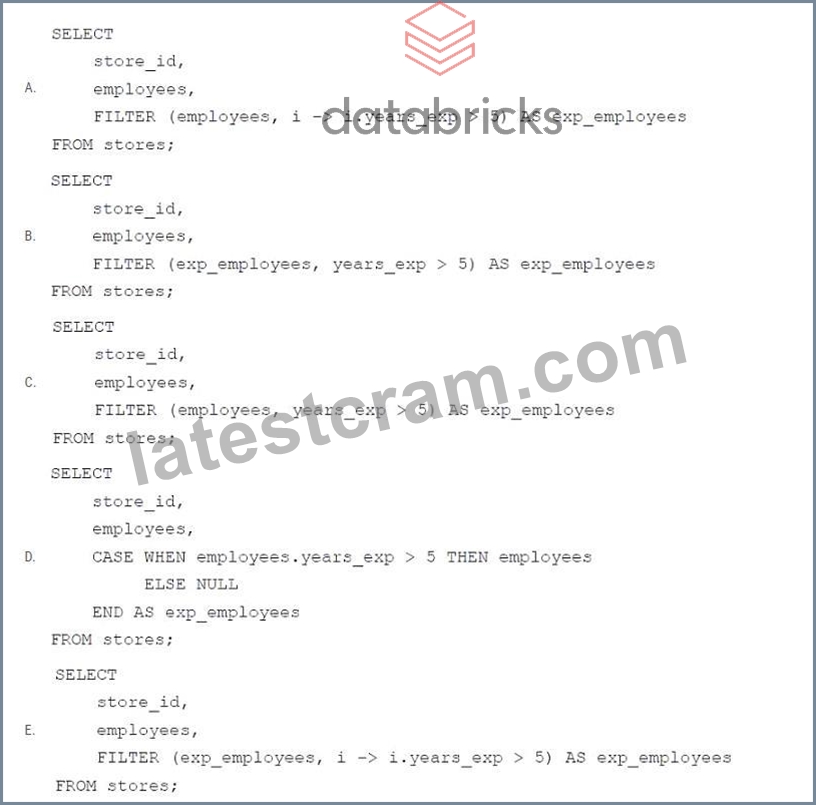
- A. Option B
- B. Option E
- C. Option D
- D. Option C
- E. Option A
Answer: E
NEW QUESTION # 77
Which type of workloads are compatible with Auto Loader?
- A. Streaming workloads
- B. Batch workloads
- C. Machine learning workloads
- D. Serverless workloads
Answer: A
NEW QUESTION # 78
A data engineer is using the following code block as part of a batch ingestion pipeline to read from a composable table: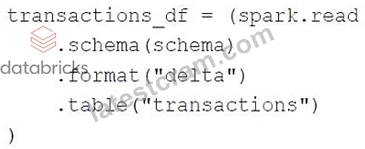
Which of the following changes needs to be made so this code block will work when the transactions table is a stream source?
- A. Replace "transactions" with the path to the location of the Delta table
- B. Replace predict with a stream-friendly prediction function
- C. Replace spark.read with spark.readStream
- D. Replace format("delta") with format("stream")
- E. Replace schema(schema) with option ("maxFilesPerTrigger", 1)
Answer: C
Explanation:
1: To read from a stream source, the data engineer needs to use the spark.readStream method instead of the spark.read method. The spark.readStream method returns a DataStreamReader object that can be used to specify the details of the input source, such as the format, the schema, the path, and the options. The spark.read method is only suitable for batch processing, not streaming processing. The other changes are not necessary or correct for reading from a stream source. Reference: Structured Streaming Programming Guide, Read a stream, Databricks Data Sources
NEW QUESTION # 79
A data engineer has been using a Databricks SQL dashboard to monitor the cleanliness of the input data to an ELT job. The ELT job has its Databricks SQL query that returns the number of input records containing unexpected NULL values. The data engineer wants their entire team to be notified via a messaging webhook whenever this value reaches 100.
Which of the following approaches can the data engineer use to notify their entire team via a messaging webhook whenever the number of NULL values reaches 100?
- A. They can set up an Alert without notifications.
- B. They can set up an Alert with a new email alert destination.
- C. They can set up an Alert with a new webhook alert destination.
- D. They can set up an Alert with one-time notifications.
- E. They can set up an Alert with a custom template.
Answer: C
Explanation:
A webhook alert destination is a way to send notifications to external applications or services via HTTP requests. A data engineer can use a webhook alert destination to notify their entire team via a messaging webhook, such as Slack or Microsoft Teams, whenever the number of NULL values in the input data reaches 100. To set up a webhook alert destination, the data engineer needs to do the following steps:
In the Databricks SQL workspace, navigate to the Settings gear icon and select SQL Admin Console.
Click Alert Destinations and click Add New Alert Destination.
Select Webhook and enter the webhook URL and the optional custom template for the notification message.
Click Create to save the webhook alert destination.
In the Databricks SQL editor, create or open the query that returns the number of input records containing unexpected NULL values.
Click the Create Alert icon above the editor window and configure the alert criteria, such as the value column, the condition, and the threshold.
In the Notification section, select the webhook alert destination that was created earlier and click Create Alert. Reference: What are Databricks SQL alerts?, Monitor alerts, Monitoring Your Business with Alerts, Using Automation Runbook Webhooks To Alert on Databricks Status Updates.
NEW QUESTION # 80
Which of the following data workloads will utilize a Gold table as its source?
- A. A job that queries aggregated data designed to feed into a dashboard
- B. A job that cleans data by removing malformatted records
- C. A job that enriches data by parsing its timestamps into a human-readable format
- D. A job that aggregates uncleaned data to create standard summary statistics
- E. A job that ingests raw data from a streaming source into the Lakehouse
Answer: A
Explanation:
A Gold table is a table that contains highly refined and aggregated data that powers analytics, machine learning, and production applications. It represents data that has been transformed into knowledge, rather than just information. A Gold table is typically the final output of a medallion lakehouse architecture, where data flows from Bronze to Silver to Gold tables, with each layer improving the structure and quality of data. A job that queries aggregated data designed to feed into a dashboard is an example of a data workload that will utilize a Gold table as its source, as it requires data that is ready for consumption and analysis. The other options are either data workloads that will use a Bronze or Silver table as their source, or data workloads that will produce a Gold table as their output. References: Databricks Documentation - What is the medallion lakehouse architecture?, Databricks Documentation - What is a Medallion Architecture?, K21Academy - Delta Lake Architecture & Azure Databricks Workspace.
NEW QUESTION # 81
A data engineer wants to schedule their Databricks SQL dashboard to refresh every hour, but they only want the associated SQL endpoint to be running when It is necessary. The dashboard has multiple queries on multiple datasets associated with it. The data that feeds the dashboard is automatically processed using a Databricks Job.
Which approach can the data engineer use to minimize the total running time of the SQL endpoint used in the refresh schedule of their dashboard?
- A. O They can set up the dashboard's SQL endpoint to be serverless.
- B. 0 They can ensure the dashboard's SQL endpoint matches each of the queries' SQL endpoints.
- C. Q They can turn on the Auto Stop feature for the SQL endpoint.
- D. O They can reduce the cluster size of the SQL endpoint.
Answer: C
Explanation:
To minimize the total running time of the SQL endpoint used in the refresh schedule of a dashboard in Databricks, the most effective approach is to utilize the Auto Stop feature. This feature allows the SQL endpoint to automatically stop after a period of inactivity, ensuring that it only runs when necessary, such as during the dashboard refresh or when actively queried. This minimizes resource usage and associated costs by ensuring the SQL endpoint is not running idle outside of these operations.
Reference:
Databricks documentation on SQL endpoints: SQL Endpoints in Databricks
NEW QUESTION # 82
Which of the following code blocks will remove the rows where the value in column age is greater than 25 from the existing Delta table my_table and save the updated table?
- A. UPDATE my_table WHERE age > 25;
- B. DELETE FROM my_table WHERE age > 25;
- C. UPDATE my_table WHERE age <= 25;
- D. DELETE FROM my_table WHERE age <= 25;
- E. SELECT * FROM my_table WHERE age > 25;
Answer: B
Explanation:
The DELETE command in Delta Lake allows you to remove data that matches a predicate from a Delta table. This command will delete all the rows where the value in the column age is greater than 25 from the existing Delta table my_table and save the updated table. The other options are either incorrect or do not achieve the desired result. Option A will only select the rows that match the predicate, but not delete them. Option B will update the rows that match the predicate, but not delete them. Option D will update the rows that do not match the predicate, but not delete them. Option E will delete the rows that do not match the predicate, which is the opposite of what we want. Reference: Table deletes, updates, and merges - Delta Lake Documentation
NEW QUESTION # 83
A data engineer has configured a Structured Streaming job to read from a table, manipulate the data, and then perform a streaming write into a new table.
The cade block used by the data engineer is below: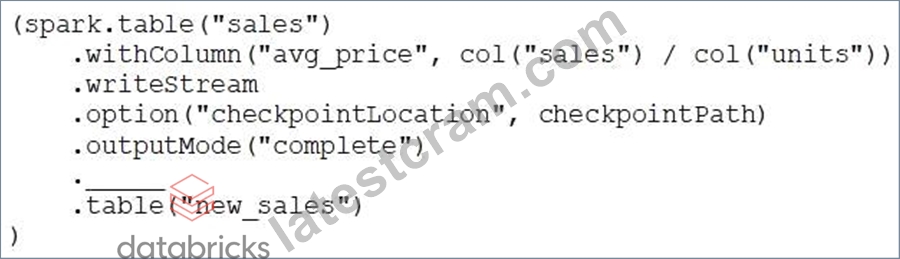
If the data engineer only wants the query to execute a micro-batch to process data every 5 seconds, which of the following lines of code should the data engineer use to fill in the blank?
- A. trigger("5 seconds")
- B. trigger(continuous="5 seconds")
- C. trigger(once="5 seconds")
- D. trigger(processingTime="5 seconds")
- E. trigger()
Answer: D
Explanation:
Explanation
# ProcessingTime trigger with two-seconds micro-batch interval
df.writeStream \
format("console") \
trigger(processingTime='2 seconds') \
start()
https://spark.apache.org/docs/latest/structured-streaming-programming-guide.html#triggers
NEW QUESTION # 84
......
Databricks-Certified-Data-Engineer-Associate Premium PDF & Test Engine Files with 111 Questions & Answers: https://www.latestcram.com/Databricks-Certified-Data-Engineer-Associate-exam-cram-questions.html
Get 100% Real Databricks-Certified-Data-Engineer-Associate Accurate & Verified Answers As Seen in the Real Exam!: https://drive.google.com/open?id=12aJYUDEPg2MMtx9dAOp1tpkBFW1pNEWs
