


In 2026, textbooks still explain everything except what the exam actually asks. LatestCram's Databricks-Machine-Learning-Professional practice questions flip the order — start from real Databricks Certified Machine Learning Professional question patterns, and absorb the theory by correcting what you miss.
Databricks Databricks-Machine-Learning-Professional Exam Overview:
| Certification Vendor: | Databricks |
|---|---|
| Exam Name: | Databricks Certified Machine Learning Professional |
| Exam Number: | Databricks-Machine-Learning-Professional |
| Real Exam Qty: | 60 |
| Related Certifications: | Databricks Certified Machine Learning Associate |
| Exam Price: | USD 200 |
| Exam Duration: | 120 minutes |
| Certificate Validity Period: | 2 years |
| Available Languages: | English |
| Exam Format: | Multiple choice |
| Passing Score: | 70% |
| Sample Questions: |  |
| Exam Way: | Online (proctored) or Test Center |
| Pre Condition: | No formal prerequisites, but 1+ years of hands-on experience performing the machine learning tasks outlined in the exam guide is highly recommended. Recommended courses: Machine Learning at Scale and Advanced Machine Learning Operations (instructor-led or self-paced via Databricks Academy). |
| Official Syllabus URL: | https://www.databricks.com/learn/certification/machine-learning-professional |
Databricks Databricks-Machine-Learning-Professional Exam Syllabus Topics:
| Section | Weight | Objectives |
|---|---|---|
| Model Lifecycle Management (MLOps) | 43% | - Automated Workflows
|
| Model Deployment | 10% | - Model Serving
|
| Model Development | 47% | - SparkML and Scaling
|
The Databricks Databricks-Machine-Learning-Professional Exam FAQ — No Fluff, Just Answers
In plain terms, the Databricks-Machine-Learning-Professional exam is Databricks's way of verifying that you deserve the ML Data Scientist certification, a credential at the Professional level. It tests the Databricks Certified Machine Learning Professional objectives through applied, scenario-driven questions — the kind that expose the gap between "read about it" and "can do it." It also sits within a broader certification ecosystem that includes Databricks Certified Machine Learning Associate, so the effort compounds across your career. That's why a review system built around realistic questions — practice, error correction, self-improvement — beats textbook re-reading every time.
The Databricks Certified Machine Learning Professional exam blueprint spans 3 domains, led by Model Deployment (10%), Model Development (47%), and Model Lifecycle Management (MLOps) (43%). Treat the weightings as your study budget: domains carrying more of the score deserve more of your week. The full topic list is in the exam topics section above — plan against it, not against guesswork.
The Databricks Certified Machine Learning Professional exam allows 120 minutes for 60 questions. Before test day, turn that into a rhythm: minutes divided by questions equals your per-item budget, and any item burning double its budget gets flagged and revisited at the end. Rehearse the rhythm under a real timer — every LatestCram test engine session runs one — and finishing with review time becomes your norm, not your hope.
Passing the Databricks Certified Machine Learning Professional exam takes 70%, and each attempt costs USD 200 — including every retake, at full price. The financially sound strategy is arriving over-prepared: drill with LatestCram practice questions until your timed scores clear the passing mark across several consecutive sessions, then register. You're not being cautious; you're declining to pay for the same exam twice.
Databricks lists the Databricks Certified Machine Learning Professional formats as: Multiple choice. Formats aren't trivia — they change how you should read. For long scenario stems, locate the actual question sentence first; for multi-answer items, verify every option you select. LatestCram's 193 practice questions cover these formats so thoroughly that on exam day, only the content is new.
You can take the Databricks-Machine-Learning-Professional exam in English. Choose the language where your comprehension is fastest under time pressure — in a timed exam, slow reading is a hidden tax on every question. Testing in English? Daily work with LatestCram's English Databricks-Machine-Learning-Professional practice questions doubles as targeted vocabulary training.
The certification earned via the Databricks Certified Machine Learning Professional exam stays valid for 2 years. Mark the expiry date early and research the recertification path before it looms — a planned renewal is an errand, an expired credential is a project. Since Databricks sets and updates these policies, confirm the current requirements on the official certification page when your window approaches.
Every version contains the same 193 expert-written questions — you're choosing a study environment:
- PDF version — printable, expert-prepared, instantly downloadable, readable anywhere, anytime. Includes 365 days of free updates and a free demo.
- Desktop Test Engine — Windows software that simulates the real exam environment, with two practice modes, offline access, and unlimited installations.
- Online Test Engine — runs in any browser on Windows, Mac, Android, and iOS, with test history and performance review built in.
Most candidates end up combining formats — PDF for reading, an engine for timed rehearsal.
Yes. LatestCram's free Databricks Certified Machine Learning Professional PDF demo contains real sample questions with verified answers, so you can evaluate the quality before paying. Every purchase includes 365 days of free updates, and renewing after that costs 50% of the regular price from your member zone. Test-drive first — confident material has nothing to hide.
Continuously. As Databricks adjusts the Databricks Certified Machine Learning Professional exam, our experts revise the bank to match — and customer feedback feeds the same review loop, so your suggestions can shape future versions. Updates are free for 365 days via your member zone; track them through the New Releases section or the LatestCram newsletter, and re-check 3-4 days before your exam. Expired products repurchase at 50% off to restart the service.
Support runs around the clock: free online consultation whenever you need it, remote guidance if you hit installation or usage issues, and patient, first-time responses to content questions by email — your suggestions are genuinely welcomed. On privacy, we solemnly protect your purchase information: transactions are secured by McAfee security services, customer data is never disclosed to third parties, and you'll never receive spam or telemarketing because of us.
Delivery first: your Databricks Certified Machine Learning Professional practice questions are downloadable instantly and emailed within one minute of payment — if 2 hours pass, check spam and contact support. Install on as many computers as you need. If the exam doesn't go your way, the 100% Money Back Guarantee applies: take the corresponding exam within 60 days of purchase, and if you don't pass, submit a scanned enrollment slip and your official Score Report PDF within 2 days after the exam — full refunds are processed within 7 days. Not eligible: attempts made within 3 days of purchase, exams never actually taken, free items, and expired orders; the candidate name must match the payer name. Prefer to keep preparing? Exchange for two free exam products of equal value and retain your update service.
Your Databricks Certified Machine Learning Professional Purchase at LatestCram, in Full
Evaluate the free demo first. When you buy, your Databricks-Machine-Learning-Professional material is downloadable instantly and emailed within one minute of payment — contact support if 2 hours pass — with unlimited installations and remote setup guidance if you need it. McAfee security services protect every transaction, your purchase information is never disclosed, and help is available around the clock.
- PDF version: printable format, prepared by experts, instant access to download, study anywhere and anytime, 365 days of free updates, free PDF demo available.
- Desktop Test Engine: installable software simulating the real Databricks Certified Machine Learning Professional exam environment, two practice modes, offline access, supports MS Windows, unlimited installations.
- Online Test Engine: instant online access from all web browsers, test history and performance review, supports Windows, Mac, Android, and iOS.
- Update service: 365 days free, driven by continuous expert review and customer feedback; expired products repurchase at a 50% discount from your member zone.
- 100% Money Back Guarantee: take the corresponding exam within 60 days of purchase, and if you don't pass, submit your enrollment slip and official Score Report within 2 days after the exam for a full refund processed within 7 days — or exchange for two free products of equal value.
Stop wrestling the textbook and start training for the exam: download the free Databricks-Machine-Learning-Professional demo, and let LatestCram's 193 practice questions turn your Databricks Certified Machine Learning Professional preparation into a system that works.
Databricks Certified Machine Learning Professional Sample Questions:
A data scientist has created a Python function compute_features that returns a Spark DataFrame with the following schema: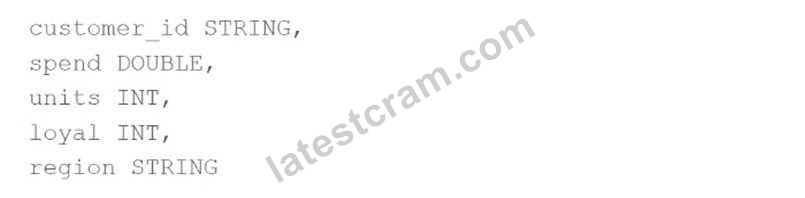
The resulting DataFrame is assigned to the features_df variable. The data scientist wants to create a Feature Store table using features_df.
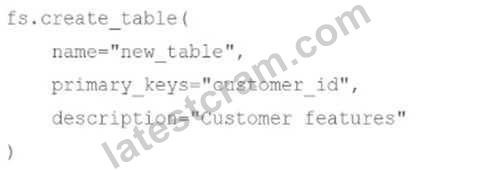
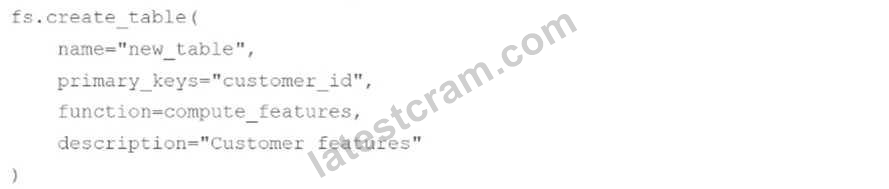
Which of the following code blocks can they use to create and populate the Feature Store table using the Feature Store Client fs?
- A.
- B. features_df.write.mode("fs").path("new_table")
- C.
- D. features_df.write.mode("feature").path("new_table")
- E.
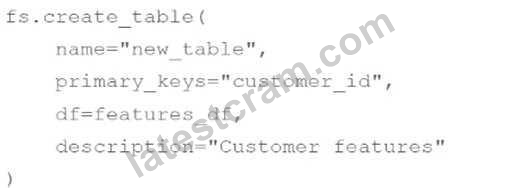
Correct Answer: C 🗳️
A machine learning engineer wants to move their model version model_version for the MLflow Model Registry model model from the Staging stage to the Production stage using MLflow Client client. Which of the following code blocks can they use to accomplish the task?
- A.

- B.

- C.
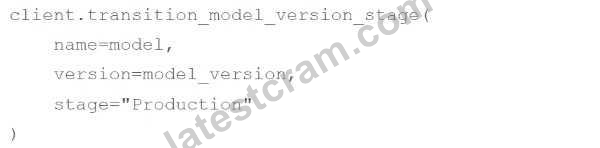
- D.

- E.
Correct Answer: D 🗳️
Label drift occurs where there is a change in which element?
- A. The distribution of an input variable
- B. The distribution of a target variable
- C. The distribution of the predicted target given by the model
- D. The relationship between input variables and target variables
Correct Answer: B 🗳️
Explanation: Only visible for LatestCram members. You can sign-up / login (it's free).
A Machine Learning Engineer is implementing integration tests for an ML pipeline in Databricks.
The current integration test runs the complete workflow but takes four hours to execute due to large dataset processing and extensive model training. They need to select an approach that will be the most effective for optimizing integration test execution while maintaining test reliability. The approach should also be based on MLOps best practices. Which approach will do this?
- A. Run integration tests only in the production environment using full datasets to ensure complete accuracy of the testing process.
- B. Replace integration tests with unit tests for each pipeline component to reduce execution time and focus on individual component validation in a staging environment that closely matches production.
- C. Skip the model training phase entirely and only test data transformations and API endpoints using mock model predictions.
- D. Use small subsets of production-like data and reduce training iterations while maintaining the same pipeline structure and validation checkpoints in a staging environment that closely matches production.
Correct Answer: D 🗳️
Explanation: Only visible for LatestCram members. You can sign-up / login (it's free).
A Machine Learning Engineer uses Lakehouse Monitoring to track their credit scoring model's performance. The existing profile metrics table contains three aggregate metrics:
- adefault_risk_score
- payment_history_score
- credit_utilization_score
They need to:
1. Create a composite risk rating that combines these three scores using weights of 0.5, 0.3, and 0.2 respectively.
2. Monitor drift of this composite score against an established baseline.
Which approach should be used to implement both requirements within Lakehouse Monitoring?
- A. Create an aggregate metric for composite_risk_rating and configure a separate drift metric to monitor changes.
- B. Use a scheduled notebook to calculate the composite score and manually insert both the score and drift values into the profile metrics table.
- C. Create two separate aggregate metrics: one for the composite score calculation and another for drift detection.
- D. Create a derived metric for the composite_risk_rating calculation and create a drift metric on this derived metric.
Correct Answer: D 🗳️
Explanation: Only visible for LatestCram members. You can sign-up / login (it's free).
Viewing page 1 out of 39 pages.
Viewing questions 1-5 out of 193 questions.


 870 Customer Reviews


