


Walk into the AI-500 exam having already been there. The Microsoft Designing and Implementing Multi-Agent AI Solutions practice exam at LatestCram fits you to the formal test atmosphere — 75 practice questions for the AI-500 exam, minimum time, maximum knowledge.
Microsoft AI-500 Exam Overview:
| Certification Vendor: | Microsoft |
|---|---|
| Exam Name: | Designing and Implementing Multi-Agent AI Solutions |
| Exam Number: | AI-500 |
| Related Certifications: | Microsoft Certified: Multi-Agent AI Solutions Expert (beta) |
| Passing Score: | 700/1000 |
| Available Languages: | English |
| Exam Format: | Microsoft certification exam (beta), Scenario-based, Case study, Active screen, Best answer, Build list, Multiple choice, Drag and drop, Multiple select |
| Exam Price: | USD $165 |
| Certificate Validity Period: | Microsoft role-based certifications are valid for 1 year after certification (renewable online). |
| Sample Questions: |  |
| Exam Way: | Online proctored or test center delivery through Pearson VUE. |
| Pre Condition: | No prerequisite exam is required to take AI-500. To earn the Microsoft Certified: Multi-Agent AI Solutions Expert (beta) certification, candidates must satisfy Microsoft's certification requirements as published on the official certification page. |
| Official Syllabus URL: | https://learn.microsoft.com/en-us/credentials/certifications/exams/ai-500/ |
Microsoft AI-500 Exam Syllabus Topics:
| Section | Weight | Objectives |
|---|---|---|
| Topic 1: Secure, govern, and deploy multi-agent solutions | 20-25% | - Design and implement guardrails
|
| Topic 2: Develop multi-agent solutions in Azure | 30-35% | - Implement multi-agent orchestration
|
| Topic 3: Architect multi-agent solutions | 15-20% | - Design logical architecture for multi-agent solutions
|
| Topic 4: Evaluate, optimize, and monitor multi-agent solutions | 20-25% | - Evaluate solution quality
|
Microsoft Designing and Implementing Multi-Agent AI Solutions Exam FAQ — Effective Answers
Delivery is instant: payment triggers an automatic email within a minute — unlimited installations, and 24/7 customer assisting for any downloading or purchasing issue if nothing arrives within 2 hours. If you fail the corresponding AI-500 exam within 60 days of purchase, choose your remedy: a full refund (scanned enrollment slip plus the official Score Report PDF within 2 days of the exam; processed within 7 days), waiting for the next updated version free, or a free change to two other equal-value dumps. Excluded: exams within 3 days of purchase, candidate names that don't match the payer, and free or expired products.
The Microsoft Designing and Implementing Multi-Agent AI Solutions blueprint spans 4 domains — including Secure, govern, and deploy multi-agent solutions (20-25%), Develop multi-agent solutions in Azure (30-35%), Architect multi-agent solutions (15-20%). Let the weightings direct your spare-time review; the full outline above lists every subtopic.
Yes — download the free Microsoft Designing and Implementing Multi-Agent AI Solutions demo and evaluate the material before paying. Purchases include 365 days of free updates, each new version emailed immediately upon release; renew afterward at 50% off.
No prerequisite exam is required to take AI-500. To earn the Microsoft Certified: Multi-Agent AI Solutions Expert (beta) certification, candidates must satisfy Microsoft's certification requirements as published on the official certification page. Eligibility rules change periodically, so confirm the current requirements on the official page (official AI-500 exam page) before registering.
The Microsoft Designing and Implementing Multi-Agent AI Solutions is Microsoft's certification exam for Microsoft Certified: Multi-Agent AI Solutions Expert, at the Expert level. It validates job-ready skills, and passing it marks you as a verified professional. Related credentials include Microsoft Certified: Multi-Agent AI Solutions Expert (beta).
USD $165 per attempt, 700/1000 to pass. A retake costs the full fee again — effective preparation with the 75 practice questions for the AI-500 exam is the economical path.
Microsoft Designing and Implementing Multi-Agent AI Solutions Sample Questions:
You have a Microsoft Agent Framework workflow. The workflow includes three specialized agents that wrap custom Hugging Face Transformers pipelines for Personally Identifiable Information (P(l) detection, sentiment classification, and summarization Each ticket must be processed by the Pll detection agent first. The sentiment classification agent must receive the redacted ticket text. The summarization agent must receive both the redacted text and the sentiment result You need to coordinate the agents to meet the dependencies.
Which orchestration pattern should you use?
- A. handoff
- B. group chat
- C. sequential
- D. concurrent
Correct Answer: C 🗳️
Explanation: Only visible for LatestCram members. You can sign-up / login (it's free).
You are designing a multitenant software as a service (SaaS) platform that uses multiple agents. Users will send latency-sensitive inference requests to the platform by using a shared API.
Initially, there will be 20 tenants, and the platform will expand to 200 tenants.
You need to identify the compute component for a production agent runtime. The solution must meet the following requirements:
Isolate workloads for each tenant by using containerization.
Dynamically scale based on demand.
Minimize administrative effort.
What should you use?
- A. Azure Kubernetes Service (AKS)
- B. Microsoft Foundry Agent Service
- C. Azure Container Instances
- D. GPU-enabled Azure virtual machines
Correct Answer: B 🗳️
You have a multi-agent solution in a Microsoft Foundry project. The project connects to an Azure Storage account named stgaudit.
You plan to enable a storage-backed tool for the agent The tool will read and write blobs to stgaudit.
You need to create a role assignment for the agent. The solution must follow the principle of least privilege.
Which role should you use?
- A. Storage Account Contributor
- B. Storage Blob Data Contributor
- C. Storage Blob Data Owner
- D. Contributor
Correct Answer: B 🗳️
Explanation: Only visible for LatestCram members. You can sign-up / login (it's free).
Solution: Use separate a managed identity for each agent and environment Assign Azure roles at the resource level. Does this meet the goal?
- A. Yes
- B. No
Correct Answer: A 🗳️
Explanation: Only visible for LatestCram members. You can sign-up / login (it's free).
You have a multitenant platform that uses Microsoft Foundry agents. The agents use conversation-based history for active turns, and the platform runs on multiple stateless container instances. Each tenant has a different transcript retention period, and users expect preferences from previous conversations to influence future sessions.
You need to persist cross-session memory after a service conversation is deleted The solution must meet the following requirements:
* Apply tenant-specific retention to transcript exports.
* Keep the compute tier stateless during scale-out.
* Minimize operational complexity
What should you include in the solution? To answer, select the appropriate options in the answer area.
NOTE: Each correct selection is worth one point.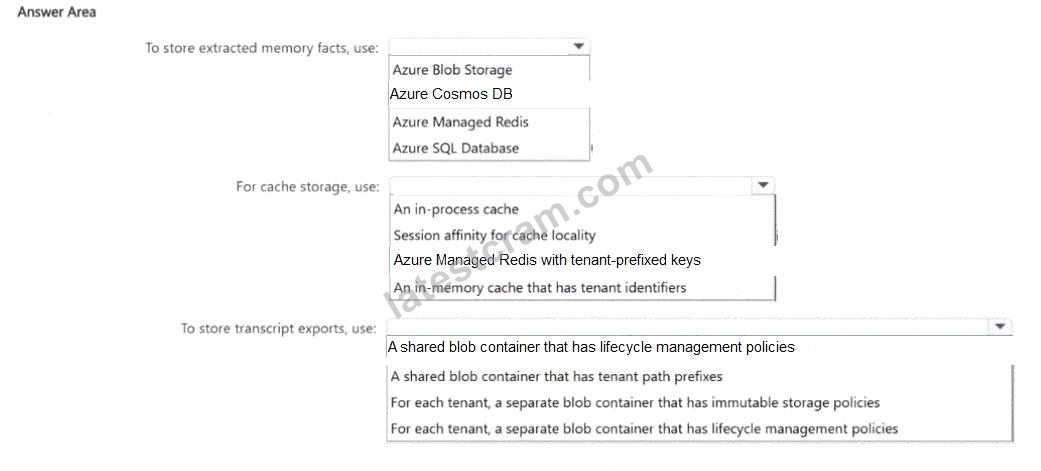
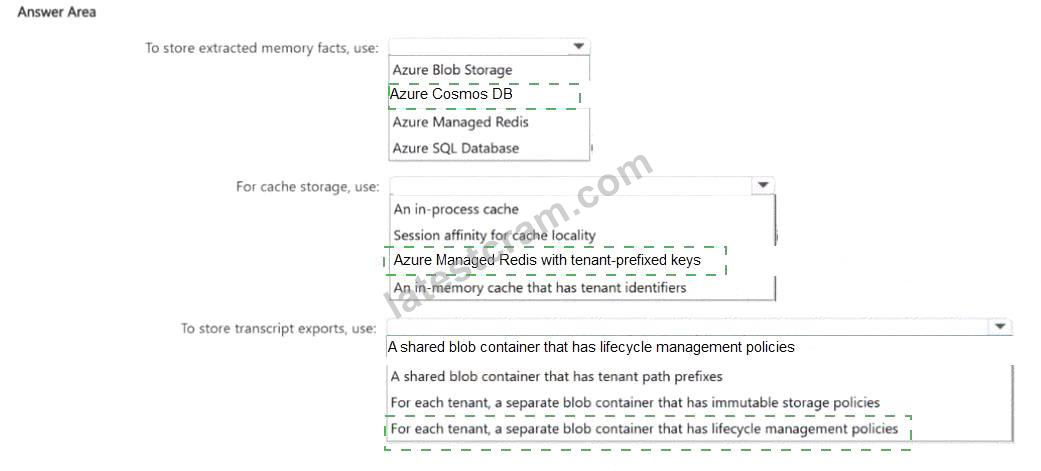
Correct Answer:
Explanation:
Extracted memory facts: Azure Cosmos DB; Cache: Azure Managed Redis with tenant-prefixed keys; Transcript exports: A shared blob container with lifecycle management policies.
The design separates durable memory, distributed cache, and retained transcripts. Azure Cosmos DB is appropriate for durable extracted facts that must survive deletion of a service conversation and remain available across stateless compute instances. Azure Managed Redis provides a shared low-latency cache; tenant-prefixed keys are a standard multitenant pattern that avoids local-process affinity. Transcript exports belong in Blob Storage, where lifecycle management rules can enforce retention and can be filtered by prefixes or tags so different tenant retention policies can coexist in one managed storage design. This combination keeps the compute tier stateless while avoiding unnecessary per-tenant infrastructure. The important security requirement is that every persistence layer also enforce tenant authorization, not just naming conventions. Within the options provided, the stated combination minimizes operational complexity while meeting cross-session persistence and retention needs. In production, add telemetry and regression tests around this behavior so changes to prompts, models, tools, or orchestration do not silently alter the intended contract. The selected approach is the one that best matches the platform ' s native execution semantics.
Official Microsoft reference: Azure Architecture Center - multitenant data and cache patterns
Viewing page 1 out of 15 pages.
Viewing questions 1-5 out of 75 questions.


 736 Customer Reviews


